 USA
USA UK
UK AU
AU UAE
UAE India Dev Centre
Two AI families dominate enterprise conversations in 2026: Google's Gemini and OpenAI's GPT. The matchup has moved on quickly, though — the models that defined earlier comparisons (Gemini's first Ultra tier and GPT-4o) are no longer the flagships. Today the meaningful contest is between Google's Gemini 3.1 Pro and the newer Gemini 3.5 Flash and OpenAI's GPT-5.5. GPT-4o still exists, but it now sits in the cheaper, lower-tier band rather than at the frontier.
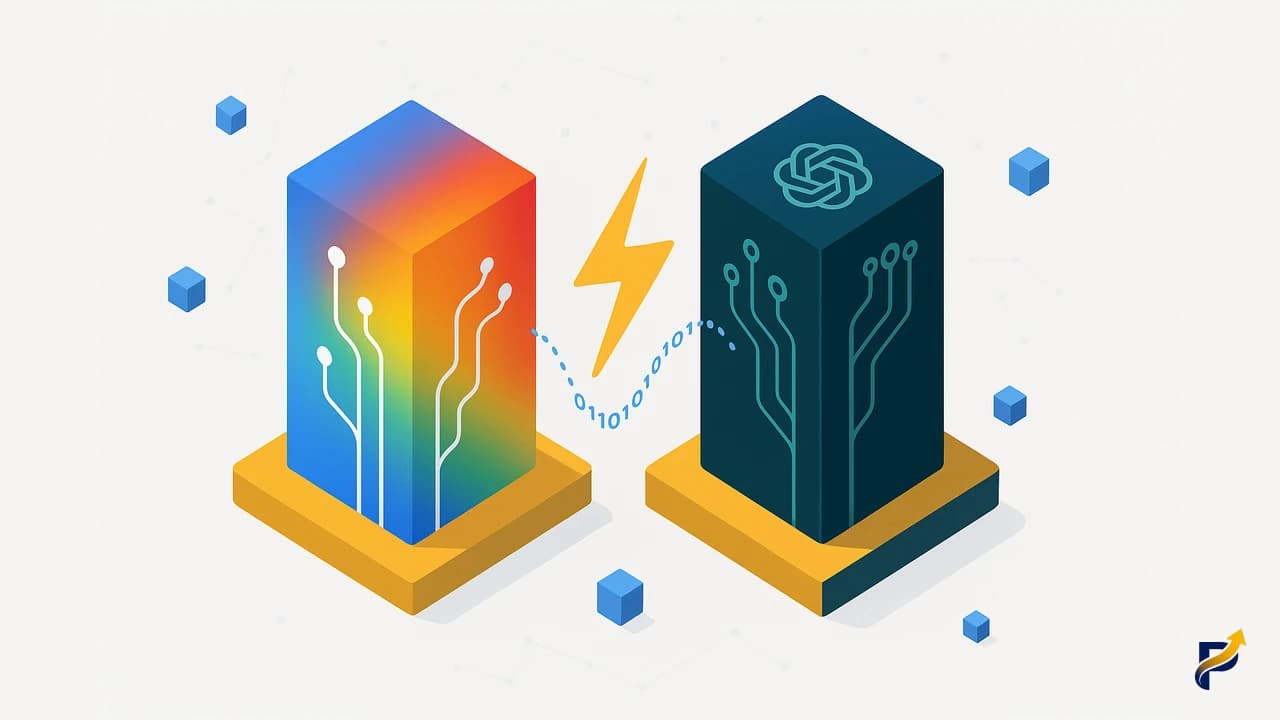
This guide is a head-to-head based on independent benchmarks and real deployment considerations, so you can choose the right model for your organisation rather than defaulting to whichever was hyped most recently.
Overview: The 2026 Model Lineup
Google's current family is Gemini 3.5. Gemini 3.5 Flash launched at Google I/O 2026 in May 2026 and, despite the "Flash" branding, outperforms the earlier Gemini 3.1 Pro on several coding and agentic benchmarks while running roughly four times faster and about 25% cheaper. Gemini 3.1 Pro remains Google's most advanced reasoning model, and Google also introduced Gemini Omni, a multimodal "world model" focused on video generation. All of these integrate deeply with Google Workspace, Vertex AI, and the wider Google Cloud stack.
OpenAI's flagship is GPT-5.5, with GPT-5.4 and GPT-5.3-Codex as lower-cost options and GPT-4o retained as a cheaper general-purpose model. GPT-5.5 is the model behind ChatGPT's enterprise tier and is also available through Azure OpenAI Service, making it the default for organisations committed to Microsoft Azure.
Both families are production-ready, extensively tested, and backed by enterprise SLAs. The comparison below focuses on where they meaningfully differ.
Reasoning and Analytical Tasks
On reasoning, the two are closely matched and the ranking shifts from benchmark to benchmark. On the demanding ARC-AGI-2 test of novel problem-solving, independent comparisons put both models in a similar high range, with results varying enough between sources that neither holds a decisive, settled lead. Where Gemini 3.1 Pro does have a clear practical edge is long-document analysis: its 1 million-token context lets reasoning span very large bodies of information in a single pass.
GPT-5.5, in turn, is exceptionally consistent on structured, well-specified reasoning and excels where the task resembles software or terminal work. For enterprise analytics over large, messy document sets, Gemini's context advantage often simplifies the architecture; for tightly scoped analytical pipelines, GPT-5.5's reliability is hard to beat.
Coding Performance
Coding is the clearest win for OpenAI in 2026. GPT-5.5 leads on the harder coding benchmarks: roughly 58.6% on SWE-Bench Pro and 82.7% on Terminal-Bench 2.0, compared with Gemini 3.1 Pro's 54.2% and 68.5%. The Terminal-Bench gap is the widest on any shared benchmark, reflecting GPT-5.5's strength on terminal-heavy, multi-file agentic coding. GPT-5.5 also posts around 88.7% on SWE-bench Verified.
Gemini is no slouch — and Gemini 3.5 Flash actually beats GPT-5.5 on multi-step tool calling (83.6% vs 75.3%) — but for pure software engineering, most teams favour GPT-5.5 or Claude Opus 4.8. Where Gemini pulls ahead is in coding that spans other media: generating code to process images or video, or building pipelines that mix text and visual data.
Multimodal Capabilities
Both families are now natively multimodal, and the gap is narrower than it once was. Gemini 3.1 Pro processes text, images, audio, video, PDFs, and entire code repositories natively, while GPT-5.5 also handles images, audio, and video. On head-to-head multimodal reasoning tests such as CharXiv, the two score within about a point of each other. Where Gemini still tends to pull ahead is document-centric work — parsing invoices that mix text, tables, and images; extracting structured data from dashboards and charts; reviewing product photos; and processing recorded meetings — helped by its native PDF and code-repository handling.
For pure text and code tasks, the multimodal difference is largely irrelevant; for enterprises with significant image, document, or media workloads, Gemini's breadth of native input types is a genuine advantage.
Context Window Comparison
The context-window gap that once separated these providers has effectively closed. Gemini 3.1 Pro and Gemini 3.5 Flash each support a 1 million-token input context, and GPT-5.5 now offers a 1 million-token context via the API as well (around 400K through Codex). One million tokens is roughly 750,000 words — the equivalent of a very large codebase or a multi-year document archive.
For most enterprise use cases, both models comfortably handle the documents and codebases involved. The decision now hinges on reasoning quality, multimodal needs, ecosystem, and cost rather than raw context size.
Enterprise Ecosystem and Integrations
Ecosystem fit is often the deciding factor. Gemini integrates natively with Google Workspace (Docs, Sheets, Slides, Gmail), Google Cloud storage and databases, BigQuery, and Vertex AI — and billing consolidates within existing Google Cloud commitments. For organisations already on Google Cloud, the integration story is seamless.
GPT-5.5 integrates natively with Microsoft 365 Copilot, Azure OpenAI Service, GitHub Copilot, and the broader Azure ecosystem. For organisations running Business Central, SharePoint, or Microsoft 365, GPT-5.5 through Azure OpenAI Service is the natural path of least resistance. For organisations without a strong Google or Microsoft commitment, the OpenAI platform retains the broadest third-party developer ecosystem in 2026.
Cost and API Access
Pricing now favours Google at the flagship tier. Gemini 3.1 Pro runs at roughly $2 per million input and $12 per million output tokens, while GPT-5.5 is about $5 and $30 — making Gemini around 2.5x cheaper for comparable frontier work. Gemini is available via Google AI Studio and Vertex AI; GPT-5.5 via the OpenAI API and Azure OpenAI Service, both with enterprise agreements for negotiated rates.
For high-volume, lower-complexity work, the cheaper tiers — Gemini 3.5 Flash, GPT-5.4, or the legacy GPT-4o — deliver strong value at a fraction of flagship cost. We recommend modelling costs across your actual task mix before committing. Our AI development team at PapaSiddhi can help you benchmark and architect a cost-efficient multi-model solution.
Which Model Is Right for Your Business?
The decision framework is straightforward once you map your primary use cases.
Choose Google Gemini if your organisation runs on Google Cloud, you have significant image, video, or document-processing needs, you value the strongest novel-reasoning performance, or cost efficiency at the flagship tier is a priority.
Choose OpenAI GPT-5.5 if your organisation runs on Microsoft Azure, your primary use case is terminal-heavy code generation and developer assistance, or you prioritise the maturity of the surrounding developer tooling and integrations. Consider Claude Opus 4.8 alongside both if you want top-tier coding reliability with a 1M context and are not locked into either cloud.
Many enterprises in 2026 adopt multi-model architectures rather than committing to a single provider — routing each task to the best-suited model and using cheaper models for high-volume simple work. This optimises both quality and cost and reduces dependency on any one vendor. PapaSiddhi Technologies helps enterprises evaluate, integrate, and operate Gemini, GPT, and Claude. Contact our team for a concrete recommendation for your use case.
Frequently Asked Questions
Common questions about Gemini vs GPT enterprise AI 2026 answered by the PapaSiddhi expert team.