 USA
USA UK
UK AU
AU UAE
UAE India Dev Centre
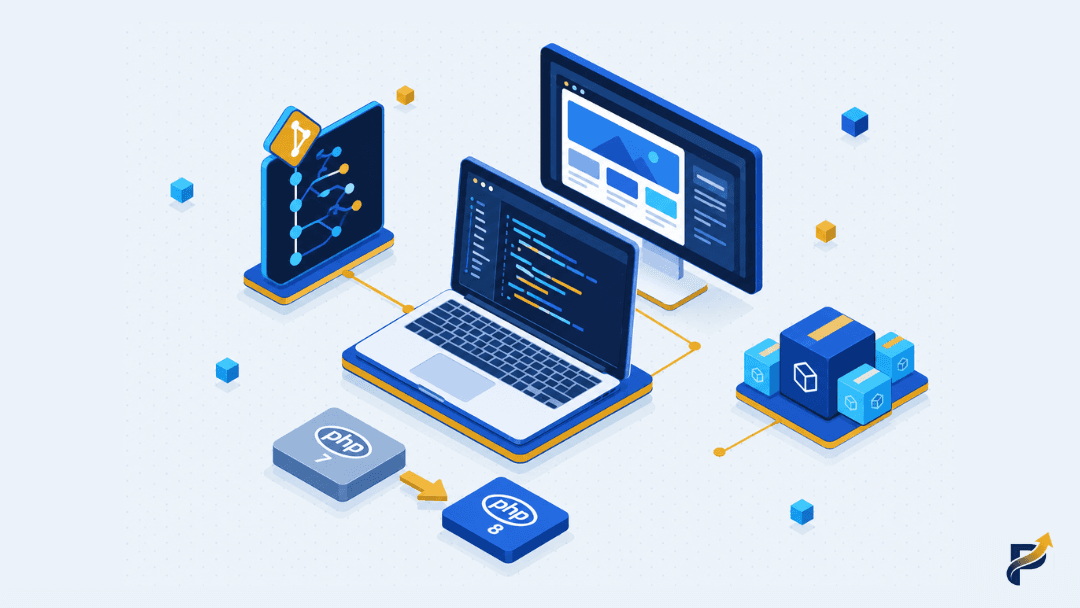
If your PHP application is still running on PHP 7.x in mid-2026, you're not alone — but you are carrying a risk that compounds every single week. Security patches stopped arriving when PHP 7.4 reached end-of-life in November 2022. Your application is now a moving target for attackers, and every quarter you delay modernisation, the gap between your codebase and current PHP standards widens further. The good news? You don't need to tear everything down and start over. Modernising a legacy PHP codebase incrementally is not only possible — industry data now shows it's the smarter, safer, and significantly cheaper path forward.
Why PHP 7 Is a Ticking Clock Your Business Can't Ignore
Industry research suggests that somewhere between 20% and 34% of production PHP applications are still running on end-of-life PHP 7.x versions as of mid-2026. That's a staggering number when you consider that PHP 7.4 lost all vendor security support almost four years ago.
What does that mean in practical terms for your business? It means that when a new vulnerability is discovered — and they are discovered regularly — no official patch will ever arrive for your version. Your developers are essentially defending a castle with no reinforcements coming. Ever.
The compliance picture is equally uncomfortable. If your application handles customer data, payment information, or anything touching GDPR or PCI-DSS standards, running end-of-life software creates direct audit exposure. Regulators and enterprise clients increasingly ask about your software stack as part of due diligence. "We're still on PHP 7" is not an answer that inspires confidence.
There's also the talent problem. PHP 8.x has been the mainstream standard long enough that your best developers — or the developers you're trying to hire — are writing modern PHP. Asking them to maintain PHP 7 code is like asking a skilled chef to work in a kitchen without heat. They'll do it, but don't expect them to stay.
Industry research from JetBrains' State of PHP 2025 confirms that PHP 8.3 is now the dominant version among active deployments globally, with adoption accelerating sharply. The community has moved. The ecosystem has moved. The question is whether your application moves with it.
One thing we hear consistently from businesses who've delayed this decision: they assumed modernisation meant a complete rewrite. It doesn't. Full rewrites succeed only around 23% of the time by some estimates, versus a 53% success rate for incremental upgrades. The math strongly favours taking the phased path — and that's exactly what the rest of this article will show you how to do.
Mapping the Upgrade Journey: PHP Versions, Breaking Changes, and What Bites Hardest
Before your team writes a single line of new code, they need a clear picture of what's changed between PHP 7 and PHP 8. Not all breaking changes are equal. Some are trivial. Others will silently corrupt your data or crash your application if you miss them.
Here's a realistic comparison of the most consequential changes across PHP versions that production teams encounter during modernisation:
| Area of Change | PHP 7.4 Behaviour | PHP 8.0 Behaviour | PHP 8.3 Behaviour | Risk Level |
|---|---|---|---|---|
Loose type comparisons (0 == "foo") | Returns true | Returns false | Returns false | Critical |
match expression | Not available | Introduced, strict typing | Fully mature | Low (new feature) |
| Named arguments | Not available | Introduced | Fully supported | Low (additive) |
null coercion in strict mode | Silent coercion allowed | Deprecation warnings | Errors thrown | High |
strlen() on arrays | Returns null | Throws TypeError | Throws TypeError | High |
preg_match invalid patterns | Returns false | Throws ValueError | Throws ValueError | Medium |
Deprecated each() function | Deprecated, still works | Removed entirely | Removed entirely | Critical |
That loose comparison change (
0 == "foo") is the one that bites most teams hardest. If your codebase uses equality checks to validate user input or compare database values — and most PHP 7 applications do — you can have logic failures that don't produce visible errors. They just make your application behave incorrectly. Silently. That's the worst kind of bug.
The each() function removal catches teams off-guard too. It was deprecated quietly enough that many developers never noticed, and older codebases have it scattered throughout data-processing loops.
The practical implication for your team: before touching a single upgrade, run PHP's official migration guides alongside a static analysis tool like PHPStan or Psalm set to your current PHP version. These tools scan your entire codebase and flag incompatibilities before they become runtime failures. Think of it as an X-ray before surgery.
A PapaSiddhi perspective worth sharing here: in our experience working across codebases ranging from 50,000 to 800,000 lines of PHP, the breaking changes that cause the most damage aren't the ones in the documentation. They're the undocumented assumptions baked into custom libraries that haven't been touched in six years. Always audit your vendor and internal library dependencies before anything else.
The Strangler Fig Pattern: Replacing Code Without Stopping the Machine
The Strangler Fig pattern — named after a vine that gradually grows around a tree until it replaces it entirely — is the architectural approach that makes incremental modernisation practical for production applications.
The concept is straightforward. Rather than rewriting your entire application at once, you identify discrete components or routes and replace them one at a time with modern equivalents. The legacy system continues running in production. Real users continue using it. Revenue keeps flowing. Each new component is built on PHP 8.x standards, tested independently, then swapped in.
This matters enormously for growing companies with live applications. A SaaS business with 400 active customers can't go dark for three months while a rewrite happens. A financial services platform can't freeze feature development while engineers tear down the architecture. The Strangler Fig approach means neither of those sacrifices is necessary.
Here's how a realistic phased timeline looks, based on codebase size:
Small codebases (under 100,000 lines of code): Phase 1 involves setting up PHPUnit test coverage and running Rector (an automated PHP upgrade tool) across the codebase — typically 6 to 8 weeks. Phase 2 upgrades the PHP version incrementally from 7.4 to 8.0, then 8.1, addressing breaking changes at each step — 8 to 12 weeks. Phase 3 migrates the highest-traffic components to modern patterns — 4 to 6 weeks. Total realistic timeline: 4 to 6 months.
Medium codebases (100,000 to 500,000 lines): Expect 9 to 14 months for the full journey, with a dedicated team of 2 to 3 PHP developers working alongside your existing product work.
Large codebases (500,000+ lines): Plan for 18 to 24 months minimum. This is where a phased framework migration to Laravel or Symfony becomes part of the strategy rather than a stretch goal.
Rector deserves specific mention. It's an open-source PHP refactoring tool that reads your code, understands PHP version rules, and automatically rewrites syntax to match your target PHP version. It doesn't catch everything — human judgement is still essential — but it can handle 60% to 70% of mechanical upgrade work automatically, dramatically reducing the hours your developers spend on repetitive changes. Even small teams with limited budgets can use Rector to accelerate the early stages of modernisation without expensive consultancy.
According to Stack Overflow's developer ecosystem insights, the combination of automated tooling and incremental deployment has become the consensus approach among senior PHP engineers precisely because it reduces human error at the most error-prone stage of any migration.
Building Your Test Harness First: The Non-Negotiable Foundation
Here's the counter-intuitive truth about legacy PHP modernisation that surprises many business owners: the first thing you need to do has nothing to do with PHP 8.
Before upgrading a single version, your team needs a test harness — a safety net of automated tests that verify your application behaves correctly. The problem? Most legacy PHP 7 codebases have little or no automated test coverage. They were built in an era when testing was optional, and the tests were "run it and see."
This feels like delay. It isn't. It's the difference between upgrading with confidence and upgrading blind.
The approach your developers should follow: start with characterisation tests — sometimes called "golden master" tests — that record what your application currently does, not what it should do. These aren't tests of correctness. They're snapshots of current behaviour. When something changes during the upgrade process, these tests will tell you immediately, even if you didn't know that behaviour existed.
Here's a concrete example. A mid-sized e-commerce platform we worked with had a legacy pricing calculation function. No tests. When upgrading to PHP 8.0, the loose comparison change mentioned earlier caused the discount logic to silently miscalculate for certain product combinations. Without characterisation tests capturing the old output, that bug would have reached production. With them, it was caught in the first upgrade pass.
The dependency upgrade ordering also matters significantly. Your sequence should be: PHP runtime version last, not first. Start by updating Composer dependencies to versions that support PHP 8.x. Then update your framework or ORM if applicable. Then upgrade the PHP version itself. Teams that reverse this order frequently find themselves stuck — PHP 8.x is running but third-party packages throw errors because they were never updated to match.
A forward-looking prediction worth considering: by 2027, we expect AI-assisted code migration tools to reduce the characterisation testing phase significantly, with tools capable of generating initial test suites from production traffic logs. The tooling is already emerging in early form. For now, manual or semi-automated approaches remain the practical standard.
This entire test-first, automate-where-possible, increment-by-increment approach is exactly where having dedicated PHP expertise — whether in-house or through an outsourcing partner — pays for itself. The decisions made in the first eight weeks of a modernisation project determine whether the next twelve months go smoothly or painfully.
Performance gains are another compelling business case for your finance team. Documented improvements of 18% to 42% in application throughput have been recorded when migrating from PHP 7 to PHP 8, primarily due to the JIT (Just-In-Time) compiler introduced in PHP 8.0. That translates directly to reduced server costs, faster page loads, and better user retention — all measurable in your analytics within weeks of completing an upgrade. If your application runs on cloud infrastructure, lower CPU utilisation means lower monthly bills. That's a return on investment you can put in a spreadsheet.
How PapaSiddhi Can Help
Modernising a legacy PHP codebase is exactly the kind of project that benefits from dedicated specialist expertise — people who've navigated these upgrade paths before and know where the hidden costs live.
At PapaSiddhi, our IT outsourcing services include dedicated PHP upgrade specialists who work directly on your codebase, following the phased Strangler Fig methodology described throughout this article. Whether you need a single senior PHP developer to lead your internal team or a full squad covering backend, QA, and DevOps, our hire developers model gets talent in place within 48 hours of onboarding. If the fit isn't right, we offer a free replacement guarantee — no difficult conversations, no wasted time.
For SMEs across the UK, US, Australia, and beyond, we've helped teams reduce technical debt, restore compliance, and unlock the performance gains that PHP 8.x delivers — without the disruption of a full rewrite. Even if your team currently has no PHP expertise internally, we can bridge that gap entirely.
Ready to understand what your upgrade path looks like? Talk to our team for a free consultation. We'll assess your current PHP version, identify your highest-risk breaking changes, and outline a realistic timeline with no obligation.
Conclusion
Modernising a legacy PHP codebase isn't a luxury for 2027 — it's a business risk decision your team needs to make now. PHP 7 is end-of-life. Security gaps are real. But a complete rewrite isn't the answer either, not when incremental approaches deliver a 53% success rate versus 23% for full rewrites.
The Strangler Fig pattern, Rector-assisted automation, a solid test harness, and careful dependency ordering give your team a proven route from PHP 7 to PHP 8 without stopping your application or burning your developers out. The performance gains, security improvements, and reduced compliance risk deliver measurable ROI. The path is clear. The tools exist. The question is simply whether you start this quarter or the next.
Frequently Asked Questions
Common questions about modernising a legacy php answered by the PapaSiddhi expert team.