 USA
USA UK
UK AU
AU UAE
UAE India Dev Centre
Your ERP system was built to run your business. But somewhere between your third spreadsheet workaround and your eleventh day of month-end close, it quietly became the thing holding your business back. Recognising when your ERP becomes a bottleneck rather than an enabler is one of the most commercially important decisions a finance or operations leader will make in 2026 — and most organisations miss it until the damage is already done.
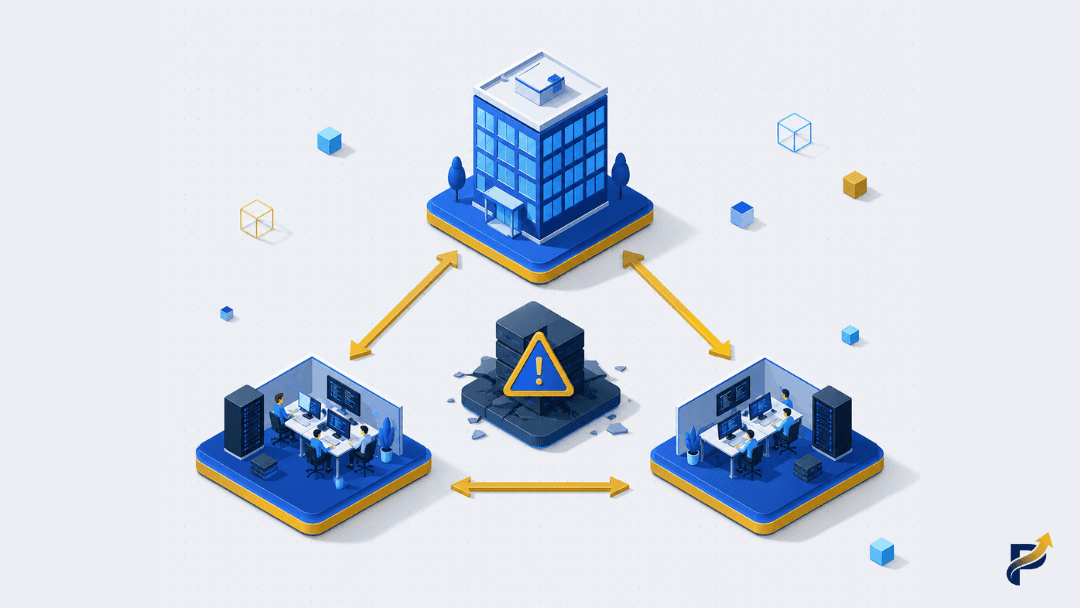
The Moment Your ERP Stops Working For You
Every packaged ERP system — whether it's SAP Business One, Oracle NetSuite, Microsoft Dynamics, or a legacy on-premise suite — is built around assumptions. Assumptions about your industry, your transaction volumes, your reporting cadence, your integrations. When your business was smaller or simpler, those assumptions roughly matched reality.
The problem is that your business evolves. Your ERP doesn't. Not in the ways that matter.
Here's what this actually looks like in practice. Your warehouse team maintains a second spreadsheet because the ERP's inventory allocation logic doesn't account for your split-location fulfilment model. Your finance director exports a CSV every Monday morning, reformats it in Excel, runs a VLOOKUP, and sends a dashboard to the board — because the native reporting module can't join the data the way the business needs. Your developers have bolted on seventeen custom modifications over five years, and nobody fully understands what breaks if you touch any of them.
This is the quiet operational cost of an outgrown ERP. It doesn't usually announce itself with a catastrophic failure. It shows up in slow month-end closes, in staff frustration, in missed reporting deadlines, and in the invisible hours your team spends working around the system rather than with it.
According to Gartner (2026), more than 70% of recently implemented ERP initiatives will fail to fully meet their original business case goals by 2027, with up to 25% failing catastrophically. That's not a technology problem alone. It's a mismatch problem — between what the system can do and what the business actually needs.
The encouraging reality is that when your ERP becomes a genuine bottleneck, there are usually clear signs long before you reach crisis point. And not all of them require a full system replacement to fix. Some need configuration. Some need integration work. Some genuinely need a rebuild. The skill is knowing which is which.
Seven Signs You've Outgrown Your Packaged ERP System
Mapping symptoms to root causes is the most practical thing you can do before spending a pound, dollar, or euro on any solution. Here are the seven signs we consistently see, and how to diagnose what's actually driving each one.
Shadow spreadsheets running critical processes. If your finance or operations team maintains Excel files that the ERP doesn't know about — files that would break real processes if they disappeared — that's a red flag. Excel workarounds signal that your ERP lacks the flexibility to model how your business actually works. The fix is sometimes configuration (enabling unused ERP modules), sometimes integration (connecting a specialist tool), and occasionally a rebuild.
Staff maintaining parallel records. Two systems of record create two versions of truth. When your stock team's numbers don't match your finance team's numbers, and both are technically "correct" in their respective systems, you have a data integrity crisis waiting to happen.
Month-end close stretching past ten days. A healthy close cycle for a mid-market business should run five to seven days. If yours consistently runs ten, twelve, or fifteen days, your ERP's financial consolidation and intercompany reconciliation capabilities are almost certainly the constraint.
Integrations held together by manual exports. Scheduled file drops, manual FTP uploads, and copy-paste data transfers between systems are not integrations. They're fragility disguised as process.
Custom code sprawl. When your ERP requires dozens of modifications just to function as intended, you're accumulating technical debt — the hidden future cost of maintaining complexity that grows over time.
Poor or delayed reporting. If your executives are making decisions based on data that's 24 to 48 hours old, your competitors with modern systems are responding to the same market signals faster than you.
Low user adoption. When staff find workarounds not because they're lazy, but because the system genuinely doesn't serve their workflow, the ERP has lost its mandate.
| Warning Sign | Likely Root Cause | Typical Fix | Complexity | Rebuild Required? |
|---|---|---|---|---|
| Shadow spreadsheets | Missing module or misconfiguration | Configuration or add-on | Low–Medium | Rarely |
| Parallel records | No single source of truth | Integration layer | Medium | Sometimes |
| Month-end close >10 days | Weak financial consolidation | Module upgrade or new ERP | High | Often |
| Manual export integrations | No API capability | Middleware or API build | Medium | Rarely |
| Custom code sprawl | Years of undocumented modifications | Code audit + refactor | High | Sometimes |
| Stale reporting (24–48hr lag) | No real-time data layer | BI integration or rebuild | Medium–High | Sometimes |
| Low user adoption | Poor UX or misaligned workflow | Training, config, or replacement | Variable | Case by case |
The diagnostic point that many consultants miss: most organisations suffering from three or more of these symptoms simultaneously are not dealing with isolated problems. They're dealing with a system that has fundamentally diverged from the business it's meant to serve.
The Real Cost of Staying Too Long
Here's a number worth sitting with. Cloud ERP adoption reached 64% in 2026, up from 44% in 2020, according to Gartner (2026). That 20-percentage-point shift in six years represents thousands of organisations that made the decision your business may still be weighing.
Why does timing matter so much? Because the cost of an outgrown ERP compounds.
Every month your finance team spends three extra days closing the books is roughly 15% of their working time absorbed by process failure rather than financial analysis. Every shadow spreadsheet your operations team maintains is a potential compliance exposure and a data breach waiting to happen. Every manual integration that breaks on a Friday afternoon costs you not just the fix, but the downstream decisions that were delayed because the data wasn't there.
Industry research consistently shows that organisations running on outgrown packaged ERP systems carry 20–35% higher operational overhead than comparable businesses on modern platforms. That overhead doesn't show up neatly on a balance sheet, but it shows up in headcount, in consulting costs, and in the opportunity cost of a leadership team firefighting system failures rather than driving growth.
There's also the integration ceiling. Legacy packaged ERP systems were built before the modern API economy — before AI tools, IoT devices, and cloud-native applications became standard parts of the enterprise technology stack. Connecting a 2010-era ERP to a 2026 AI-powered demand forecasting tool isn't impossible, but it's expensive, fragile, and usually requires middleware workarounds that create their own maintenance burden.
The counter-intuitive observation here — and one we've validated across multiple client engagements — is that the organisations most reluctant to change ERP are often the ones who invested most heavily in customising their existing system. The sunk cost of those modifications creates a psychological anchor that keeps businesses trapped in a system that's actively costing them more than a replacement would. Recognising that anchor is a leadership challenge as much as a technical one.
A forward-looking prediction for 2027: we expect to see a significant wave of mid-market organisations moving from monolithic ERP replacements to composable ERP architectures — modular systems where best-of-breed components handle specific functions (finance, supply chain, HR) and connect through a unified integration layer. This approach lets growing companies like yours swap out individual components as needs evolve, rather than betting the entire business on a single vendor's roadmap.
A Practical Guide: Configuration, Integration, or Rebuild?
Before you sign a contract for anything — a new ERP, a system integrator, an outsourced development team — run this diagnostic honestly.
Start with a two-week process audit. Ask every department head to document, in plain language, the five things their team does every week that the ERP either can't do or does badly. You're looking for patterns. If the same limitations appear across finance, operations, and sales independently, that's systemic. If one department has niche needs the system doesn't meet, that's usually solvable with configuration or a point solution.
Classify your workarounds. Separate your spreadsheet workarounds into two buckets: those that compensate for missing functionality that should be in any ERP, and those that compensate for business-specific logic that's genuinely unusual. The first bucket points toward a better-configured or better-suited ERP. The second bucket is where custom development often legitimately earns its cost.
Audit your custom code. If you have a development team or an IT partner, ask them to produce a list of every modification made to your ERP over its lifetime. If that list doesn't exist — and in our experience, it often doesn't — that absence itself is diagnostic. Undocumented customisations are a rebuilding argument in many cases.
Test your integration ceiling. Ask your IT team or a trusted partner to prototype an integration between your current ERP and one modern tool you'd benefit from — a real-time BI dashboard, an AI forecasting tool, a customer portal. If that prototype takes more than four weeks to build and test, your ERP's API capability (its ability to talk to other systems) is a genuine constraint.
Even if you don't have an internal technical team, this process is reachable. A competent technology partner can run this diagnostic in three to four weeks and give you a clear recommendation — configuration, integration, or rebuild — with honest cost estimates for each path. You don't need a huge budget to get clarity. You need the right questions and someone who's done it before.
The organisations that handle ERP transitions most successfully share one characteristic: they make the decision based on total cost of staying, not just cost of changing.
How PapaSiddhi Can Help
At PapaSiddhi Technologies, we specialise in exactly this inflection point — when your ERP becomes the thing holding your business back rather than moving it forward.
Our IT outsourcing services include dedicated ERP diagnostic engagements where our senior consultants map your current system against your actual operational needs, not your original implementation spec. We identify precisely which gaps are configuration problems, which are integration problems, and which genuinely require a platform change.
For businesses moving to or extending Microsoft Dynamics 365, our Business Central specialists cover the full implementation lifecycle, including data migration, custom development, and third-party integrations. For teams needing AI-powered reporting or demand forecasting layers on top of existing ERP infrastructure, our AI and ML development team builds those connections without requiring a full system replacement.
You can hire dedicated ERP developers through PapaSiddhi on a flexible model — whether you need a single integration specialist or a full delivery team. We onboard within 48 hours and back every placement with a free replacement guarantee if the fit isn't right.
Global businesses across the UK, US, Australia, and the Middle East work with us for exactly this kind of structured, jargon-free technology guidance. Talk to our team today to book a free consultation.
Conclusion
Recognising when your ERP becomes a bottleneck is genuinely difficult — not because the signs are subtle, but because they accumulate gradually and each one seems manageable in isolation. Shadow spreadsheets, stretched month-end closes, manual integrations, custom code nobody fully understands: these aren't minor inconveniences. They're compounding costs with a trajectory.
The good news is that clarity is achievable quickly. A structured diagnostic — honest, process-level, department by department — almost always reveals whether you need configuration, integration, or a rebuild. Most businesses are surprised to find the answer is more targeted than they feared.
Act on the signals before they become a crisis. The organisations gaining ground in 2026 are the ones who made that call six months ago.
Frequently Asked Questions
Common questions about when your erp becomes answered by the PapaSiddhi expert team.