Manufacturing
Manufacturing Operations ERP for Van **** Industrial, Netherlands
Delivered in approximately five months with a small dedicated team, phased so assembly never stopped.
A mid-sized sports equipment manufacturer based in the Netherlands, supplying retailers and clubs across the Benelux region, needed to replace a fragmented mix of spreadsheets and a legacy accounting package that could no longer keep pace with its growth. Operating three warehouse locations, the company lacked a single, real-time view of inventory, purchasing, and finance.
Business Central went live across all three warehouses in 14 weeks.
Project Highlights
Scalable Architecture
Built for growth — ERP Implementation designed to scale
Secure & Compliant
Enterprise-grade security and data protection standards
Measurable ROI
Manual multi-warehouse chaos → Real-time BC inventory across 3 sites
Netherlands Delivery
Delivered for a Netherlands-based Manufacturing & ERP client
Tech Stack
Last updated:
Industry
Manufacturing & ERP
Sector
Sports Equipment Manufacturing
Region
Netherlands
Project Type
ERP Implementation
The client is a mid-sized sports equipment manufacturer based in the Netherlands, supplying retailers and sports clubs across the Benelux region from three warehouse locations. Its range spans fast-moving lines and slower specialist products, and its customers expect accurate stock availability and prompt dispatch, especially in the run-up to each sporting season.
Growth had outpaced its systems. A fragmented mix of spreadsheets and a legacy accounting package could no longer give finance and operations a shared, real-time view of inventory, purchasing and margins. With plans to open further distribution points across Europe, the business needed an ERP that would standardise processes across sites, handle Dutch VAT and reporting properly, and scale without adding headcount to manual administration.
This project was delivered under a Non-Disclosure Agreement. The client operates in the Manufacturing & ERP sector (Sports Equipment Manufacturing) and is based in Netherlands. More on how we work with Dutch companies.
Each warehouse managed its inventory independently, so stock records rarely matched physical counts. Popular lines ran out while slow movers piled up, and there was no consistent product costing, which made margin analysis by product line little more than guesswork. Purchasing decisions were reactive and often relied on emergency orders. Warehouse teams had no visibility of stock held at the other two sites.
Order handling compounded the problem. Sales orders captured in one system had to be re-keyed into the accounting package, introducing errors and delaying dispatch. Month-end close stretched to eight working days because finance manually consolidated figures from separate spreadsheets. The new system also had to process Dutch VAT and intrastat reporting with minimal manual intervention and support GDPR (AVG) obligations around customer and supplier data.
Manual multi-warehouse chaos
Real-time BC inventory across 3 sites
PapaSiddhi implemented Microsoft Business Central on a single tenant across all three warehouses, configuring the Finance, Inventory, Sales and Purchasing modules around the manufacturer's actual workflows. Each location was set up as its own warehouse with dedicated bins and stock, while sharing one item master and chart of accounts so data stayed consistent group-wide.
Our developers built targeted AL extensions to automate per-location reorder points, streamline inter-warehouse stock transfer workflows and add custom product-line margin and profitability reporting that standard Business Central lacked. Existing eCommerce and EDI order feeds were integrated through REST API and OData endpoints, so sales flow straight into Business Central without re-keying. Dutch VAT, intrastat and local reporting were configured to run automatically.
Historical inventory, supplier and financial data were migrated and reconciled before go-live. Role-based training was delivered to finance, warehouse and purchasing teams, followed by four weeks of hypercare support to stabilise the new processes. Configuration choices were documented so that additional European sites can be added to the same tenant using a proven template rather than a fresh implementation.
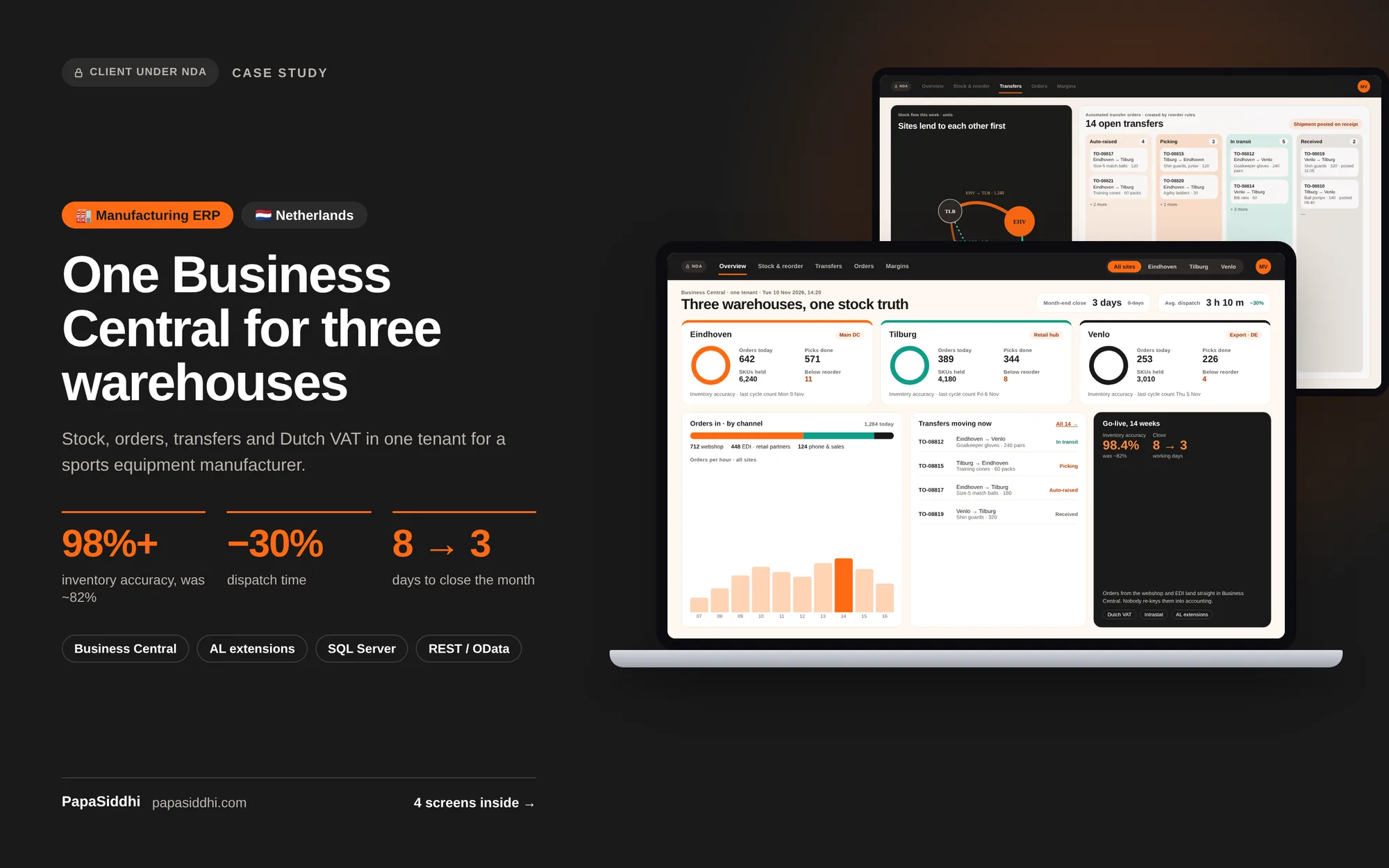
Business Central went live across all three warehouses in 14 weeks. Inventory accuracy rose from around 82% to over 98%, sharply reducing stock-outs and emergency purchases. Automated order capture eliminated duplicate data entry, and dispatch times improved by roughly 30%. Month-end close shortened from eight working days to three, and finance gained reliable, real-time margin reporting by product line for the first time. With a single source of truth across sites, management could plan purchasing and stock allocation with confidence, and the platform is now ready to extend to new European locations.
Transformation Summary
Manual multi-warehouse chaos → Real-time BC inventory across 3 sites
This project was delivered under a Non-Disclosure Agreement (NDA). Specific client details, business data, proprietary workflows, and project credentials remain confidential. Screenshots and live URLs are available upon mutual NDA execution.
Request an NDA to see full detailsIt is achievable for a comparable scope — Finance, Inventory, Sales and Purchasing on a single tenant with clean-ish source data. The timeline compresses or extends mainly on data quality and decision speed on your side; if inventory records are unreliable or the chart of accounts is contested internally, that is where weeks are added, not in the configuration.
We set all three up as separate warehouses with their own bins and stock but sharing one item master and chart of accounts, and that is usually the right structure for a single legal entity operating multiple sites. Separate companies only make sense where the entities are legally distinct and file separately — otherwise you recreate the consolidation problem you are trying to solve.
No — that is exactly why we used AL extensions rather than modifying the base application, which is the old NAV approach that made upgrades painful. Extensions sit alongside the standard product and survive Microsoft's update cadence; we built reorder point automation, inter-warehouse transfers and product-line margin reporting this way precisely to keep you upgradeable.
Dutch VAT and intrastat come from Microsoft's Netherlands localisation and are configured rather than built, which is one of the strongest arguments for Business Central in the Dutch market. The work is in configuring it correctly against your actual transaction types and validating it against real filings before go-live, not in developing it.
The initial lift came from migrating and reconciling stock properly, but it holds because there is now a single item master and transfers between sites are recorded transactions rather than informal movements. Accuracy degrades again if physical processes are not followed, which is why warehouse team training and four weeks of hypercare were part of the project rather than optional extras.
Let's discuss your project and create a success story together.

Manufacturing
Delivered in approximately five months with a small dedicated team, phased so assembly never stopped.

Manufacturing
All four branches went live in approximately four months with a small dedicated team, ahead of the compliance deadline.

Manufacturing
Delivered in approximately three months with a small dedicated team.