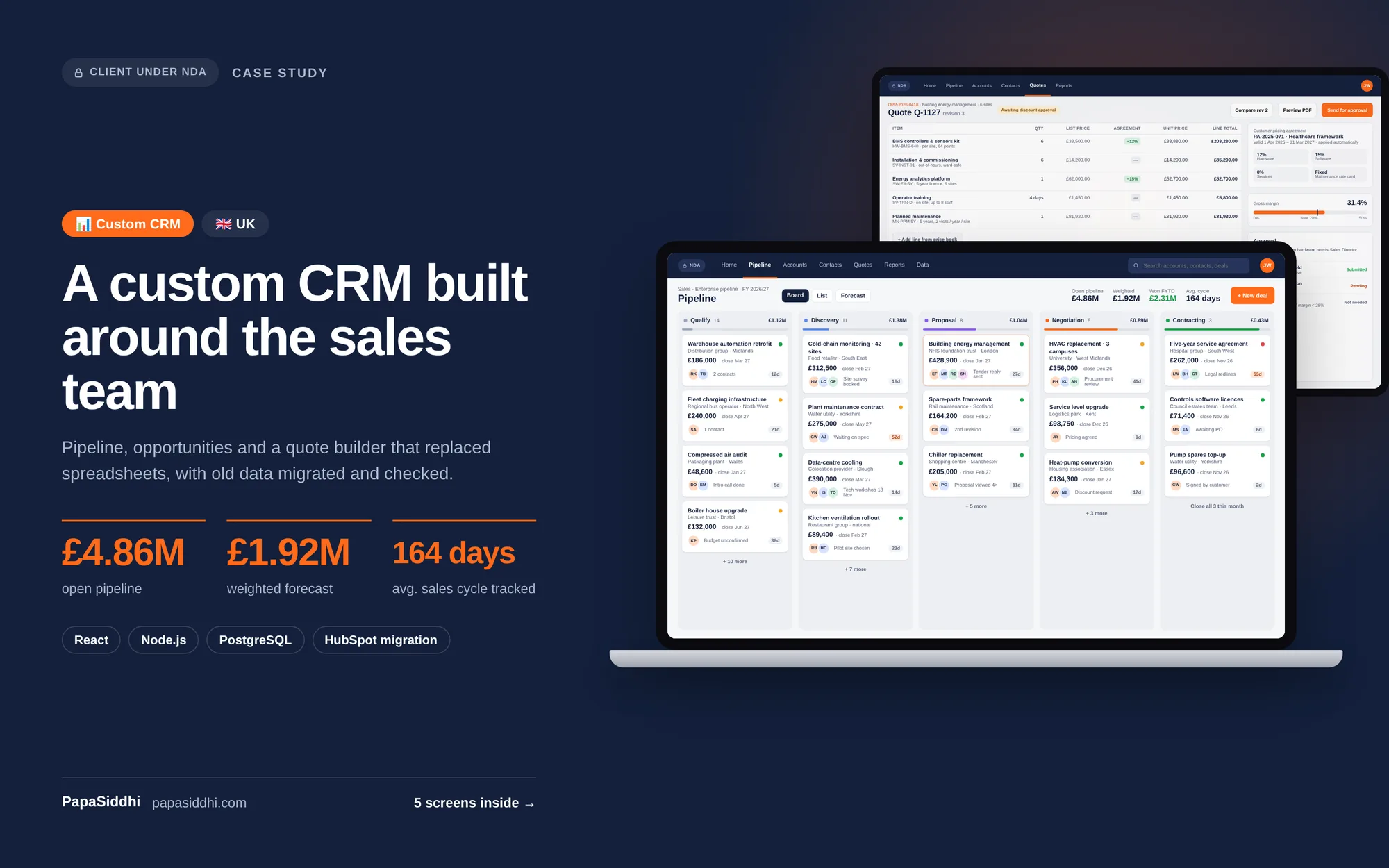
B2B Services
Custom CRM for Cla**** Group, UK
Delivered in approximately three months with a small dedicated team, including the migration.
ReactNode.jsPostgreSQL
United Kingdom·Fixed PriceView Study →
A diversified business group in Saudi Arabia, spanning industrial and consultancy divisions across four legal entities, needed to replace disconnected accounting systems with a single, compliant ERP. Each entity kept its own books, making group consolidation a slow, manual, and error-prone process.
All four entities went live on Business Central within the 18-week target, fully compliant with ZATCA Phase 2 e-invoicing from day one.
Project Highlights
Scalable Architecture
Built for growth — Multi-Entity ERP Implementation designed to scale
Secure & Compliant
Enterprise-grade security and data protection standards
Measurable ROI
4 entities on separate systems → Unified BC platform with ZATCA compliance
Saudi Arabia Delivery
Delivered for a Saudi Arabia-based Professional Services client
Tech Stack
Last updated:
Industry
Professional Services
Sector
Diversified Business Group
Region
Saudi Arabia
Project Type
Multi-Entity ERP Implementation
The client is a diversified business group based in Saudi Arabia, operating industrial and consultancy divisions through four separate legal entities. Its industrial companies and its advisory practice serve different customers, bill in different ways and run on different operational rhythms, yet the group's leadership needs to manage them as one business with one set of priorities. Like many Saudi groups that have grown venture by venture, each company had adopted whichever accounting tool suited it when it was established, and those choices were never revisited as the group expanded.
Technology moved up the leadership agenda when two pressures arrived at once. Executives wanted a timely, group-wide picture of performance across both divisions rather than figures assembled long after the period had closed. At the same time, the Zakat, Tax and Customs Authority (ZATCA) was enforcing Phase 2 of its FATOORA e-invoicing programme, which requires taxpayers to integrate their invoicing systems directly with the authority. For a group trading actively across the Kingdom, the finance function needed a single platform capable of delivering both consolidation and compliance.
This project was delivered under a Non-Disclosure Agreement. The client operates in the Professional Services sector (Diversified Business Group) and is based in Saudi Arabia. More on how we work with Saudi companies.
Group consolidation was the most visible pain point. Each of the four entities used a different accounting package with its own chart of accounts, so producing group figures meant exporting ledgers, mapping accounts by hand and reconciling the results in spreadsheets. That exercise consumed the finance team for close to two weeks every reporting period. Intercompany balances between the industrial and consultancy companies rarely agreed on the first attempt, and tracing the differences turned closing into an investigation rather than a review.
ZATCA Phase 2 added a hard technical requirement on top of the reporting problem. Every invoice had to be produced in the authority's prescribed structured format, cryptographically stamped and cleared with the tax authority in near real time before it could be treated as valid. None of the legacy systems could generate, sign or transmit invoices in that way, and bolting separate compliance tools onto four different packages would have multiplied the integration effort and the risk of inconsistency between entities.
The delivery constraints were just as demanding. The group could not pause trading while systems were replaced, and the entire programme had to land within an 18-week window to align with the compliance deadline. Leadership also wanted the new platform to fix the lack of visibility across divisions, not simply replicate the old fragmented reporting in a new tool, which meant the design work on accounts and dimensions had to be settled early.
4 entities on separate systems
Unified BC platform with ZATCA compliance
PapaSiddhi implemented Microsoft Business Central for all four entities on a single tenant hosted on Azure. The foundation was a standardised, group-wide chart of accounts with consistent dimensions, so the industrial and consultancy divisions could be analysed side by side without remapping. Intercompany postings were automated so a transaction raised in one company creates its matching entry in the counterpart, and a dedicated consolidation company now assembles group figures directly from live ledger data instead of from exported spreadsheets.
For compliance, our developers built the ZATCA e-invoicing integration in AL, Business Central's extension language, orchestrated with Power Automate. The integration connects Business Central to the ZATCA platform through its API, generating each invoice in the required format, applying the cryptographic stamp and submitting it for clearance automatically for every entity. REST and OData endpoints expose the consolidated data, and Power BI dashboards sit on top of it to give executives near real-time views of revenue, margin and performance by division.
Delivery was phased to protect day-to-day trading. Historical financial data for all four entities was migrated into Business Central and opening balances were reconciled entity by entity before cutover. The ZATCA integration was run through the authority's required validation process ahead of go-live, and each entity's finance team received phased, role-specific training so users were confident in the new processes before their company switched over.
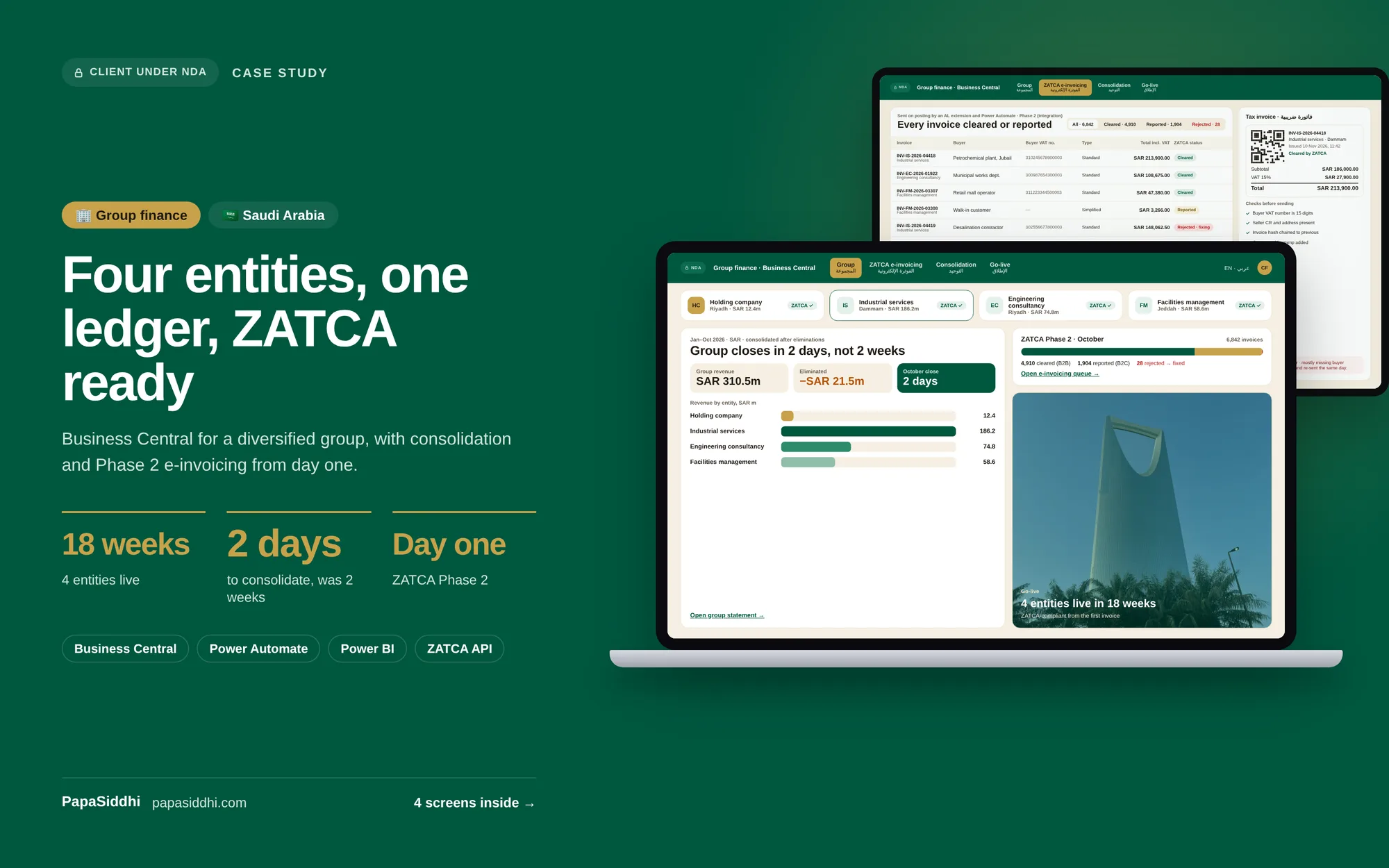
All four entities went live on Business Central within the 18-week target, fully compliant with ZATCA Phase 2 e-invoicing from day one. Group consolidation that previously took nearly two weeks now completes in a couple of days from live data, and intercompany balances reconcile automatically. Leadership gained real-time Power BI dashboards spanning both the industrial and consultancy divisions, replacing after-the-fact spreadsheet reporting. With a single chart of accounts and standardised processes across entities, the group has a scalable finance platform ready to absorb future acquisitions, and compliance risk around e-invoicing has been removed.
Transformation Summary
4 entities on separate systems → Unified BC platform with ZATCA compliance
This project was delivered under a Non-Disclosure Agreement (NDA). Specific client details, business data, proprietary workflows, and project credentials remain confidential. Screenshots and live URLs are available upon mutual NDA execution.
Request an NDA to see full detailsWe built the integration using AL and Power Automate, connecting Business Central directly to the ZATCA platform so invoices are generated in the required format, cryptographically stamped and cleared automatically for every entity. Because Phase 2 requires standard invoices to be cleared before issue, this sits in the live invoicing path — it is not a batch report, which is why failure handling and retry logic matter as much as the happy path.
It was here, but that timeline assumed a deliberately constrained scope — a standardised group chart of accounts rather than preserving four legacy structures, and phased training rather than a single event. Four entities in 18 weeks works when the group accepts standardisation; it does not work if each entity negotiates to keep its existing processes.
All four sit on a single tenant with a standardised chart of accounts and consistent dimensions for division-level reporting, plus a dedicated consolidation company that produces group figures from live data. Intercompany transactions are automated, which is why balances now reconcile automatically instead of requiring the investigation that previously stretched close to two weeks.
It does, and it is worth raising early — Saudi groups frequently hold entities on different bases, with zakat applying to Saudi and GCC-owned entities and corporate income tax to foreign-owned ones. Dimensions and entity-level configuration handle the reporting separation, but the tax determination itself is a matter for your tax advisers, not something the ERP decides.
Substantially less than the first four, because the standardised chart of accounts, dimension structure and ZATCA integration already exist — a new entity inherits them rather than requiring a fresh design. The remaining work is opening balance migration and reconciliation for the acquired business, which is the part that scales with its data quality rather than with your platform.
Let's discuss your project and create a success story together.
B2B Services
Delivered in approximately three months with a small dedicated team, including the migration.
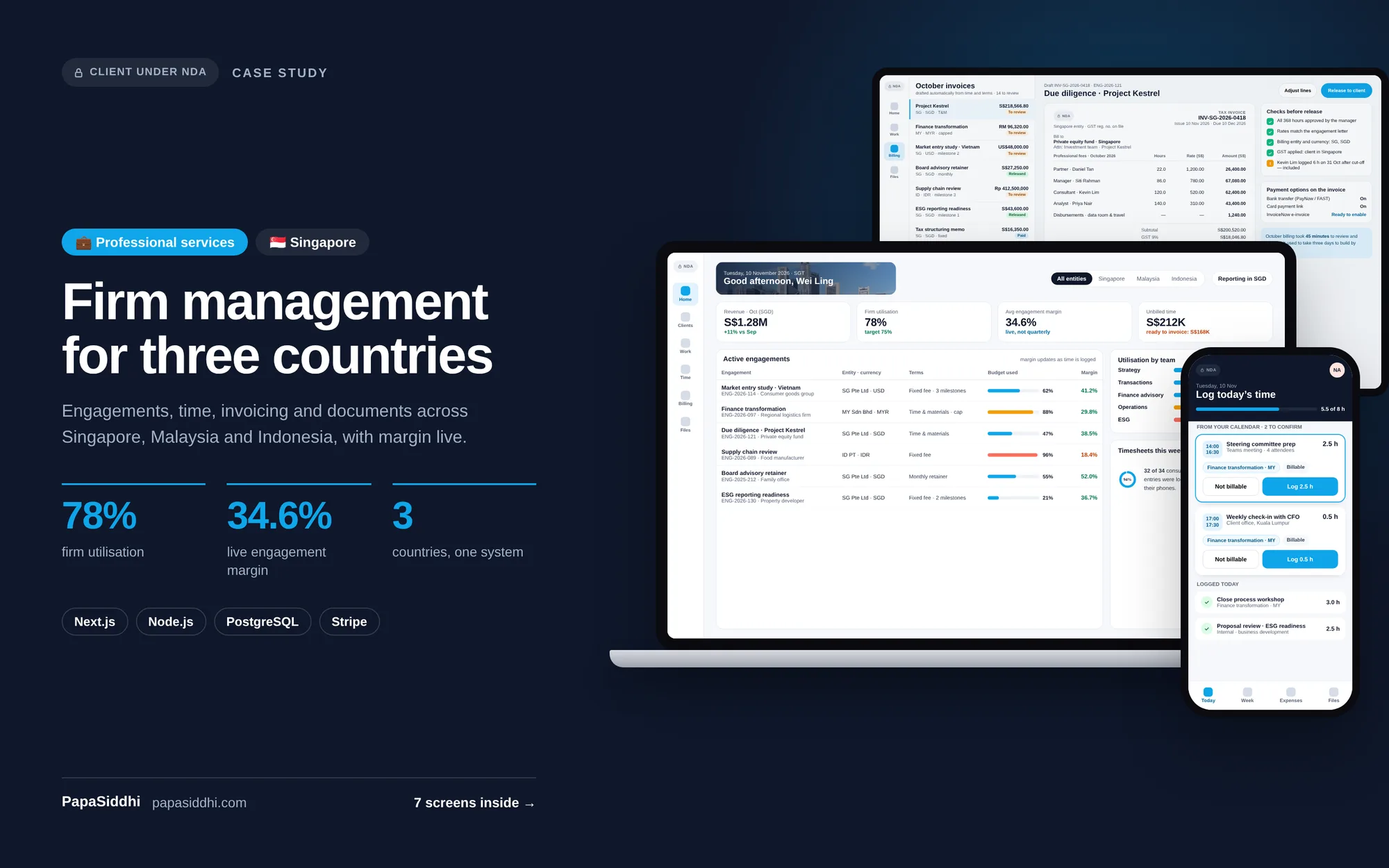
Professional Services
Delivered in approximately four months by a small dedicated team.
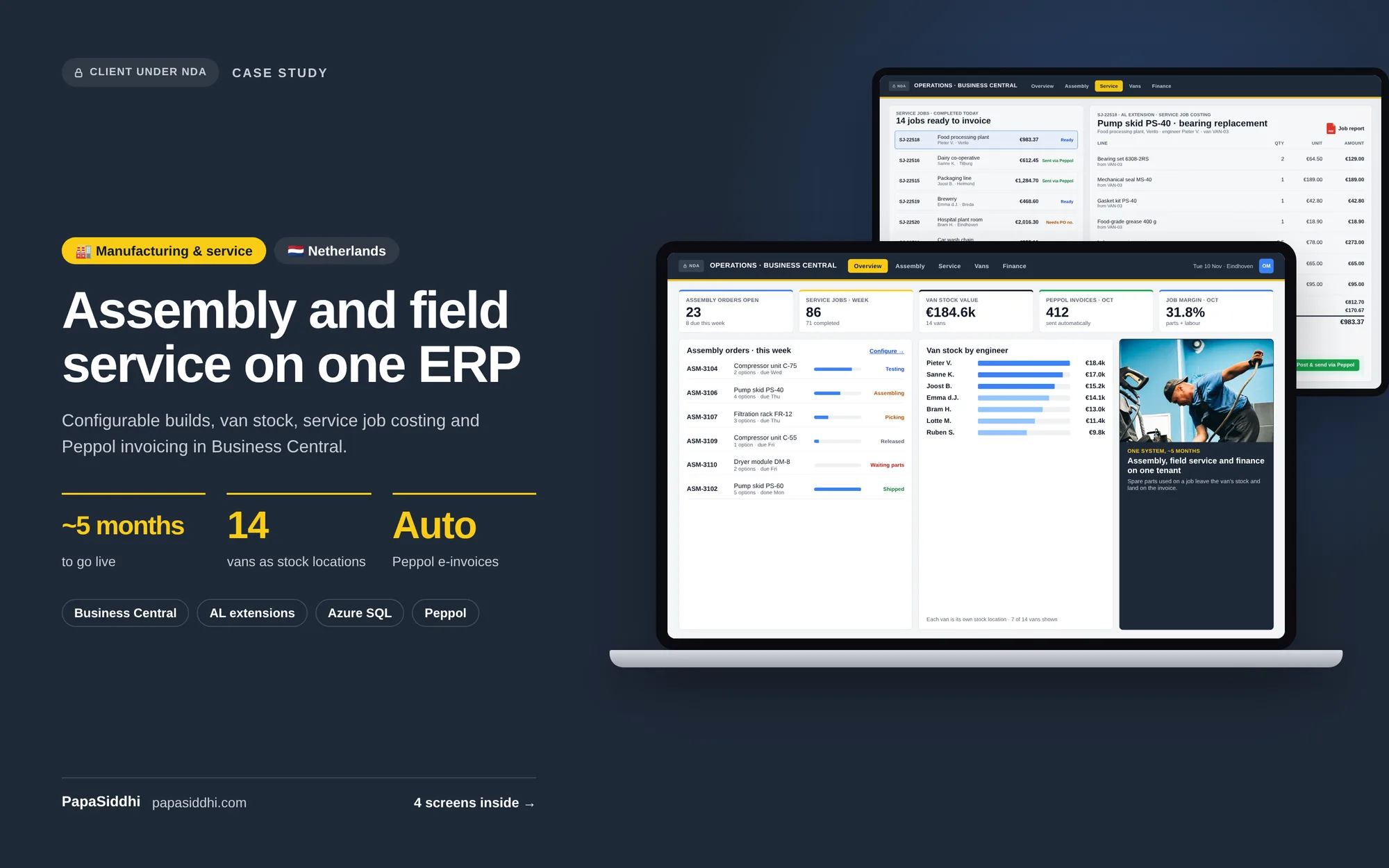
Manufacturing
Delivered in approximately five months with a small dedicated team, phased so assembly never stopped.