 USA
USA UK
UK AU
AU UAE
UAE India Dev Centre
Outsourcing software development to India is one of the most well-trodden paths in technology — and also one of the most misunderstood. For every company that has scaled brilliantly on an Indian engineering team, there is another that got burned by a cheap quote and poor oversight. The difference is rarely the country; it is the approach.
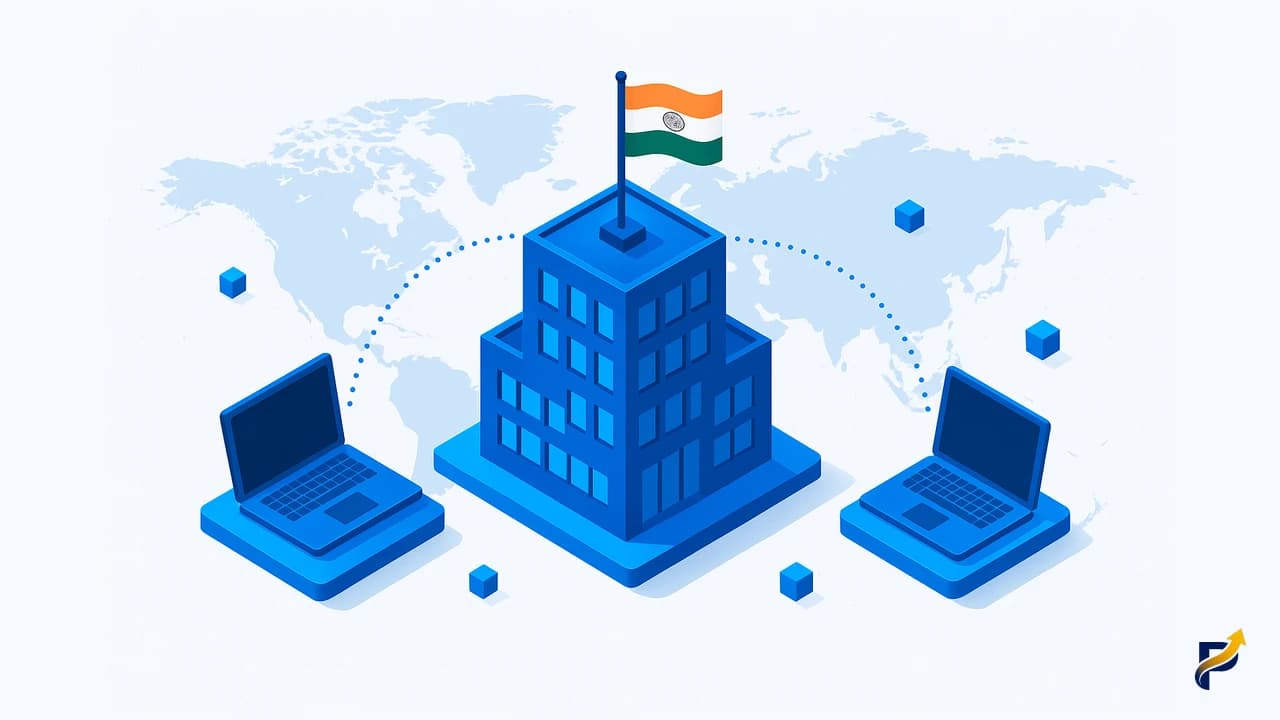
This is a balanced, honest guide for 2026: the genuine benefits, the risks nobody puts in the sales deck, how to mitigate each one, and a step-by-step plan to get it right.
Why India Still Leads IT Outsourcing in 2026
India produces more software engineering graduates than any other country and has spent three decades building the delivery infrastructure, English-language fluency, and process maturity that global clients depend on. The scale is staggering: according to NASSCOM's Strategic Review, the Indian technology industry reached roughly $282.6 billion in revenue in FY2025 (up 5.1% year on year) and is on track to approach the $300 billion milestone in FY2026, employing a workforce of around 5.8 million people. The result is a deep, mature talent pool across virtually every modern stack — from React and Node to Microsoft Business Central, Power Platform, data engineering, and AI.
What has changed in 2026 is the level of the work. India is no longer just a destination for low-cost maintenance; it is where serious product engineering, cloud architecture, and AI implementation happen for companies of every size. The rise of Global Capability Centres — now numbering over 1,900 and employing more than 1.6 million people in India — shows that even the world's largest enterprises now treat India as a strategic engineering base, not just a back office.
The Real Cost Savings (With an Honest Breakdown)
The headline is real: Indian engineering talent typically costs 50–65% less than equivalent senior talent in the USA, UK, or Western Europe, with the gap often wider at junior and mid levels. But the honest version includes more than salary.
You also save on recruitment fees, benefits and payroll overhead, office and equipment costs, and the enormous hidden cost of a slow or failed local hire. Against that, budget realistically for management time, some communication overhead, and onboarding. Net, the savings are substantial — but they come from running the engagement well, not from simply paying less per hour. Tellingly, Deloitte's 2024 Global Outsourcing Survey found that access to skilled talent and agility now rank alongside cost reduction as the top reasons enterprises outsource — and that 83% of executives are already weaving AI into their outsourced services.
India vs Other Outsourcing Destinations
India is not the only option, and an honest guide acknowledges the alternatives. Eastern Europe (Poland, Romania, Ukraine) offers strong engineering and convenient European time zones, but at higher rates and shallower scale. Latin America (Mexico, Brazil, Argentina) is increasingly popular for US "nearshore" work because of overlapping hours, though the talent pool is smaller. The Philippines excels at customer support and back-office work but is less deep in complex software engineering.
Where India wins is the combination: unmatched scale, the broadest range of modern skills, mature delivery processes, strong English, and a price point that remains highly competitive even as the work moves up the value chain. For most companies that need to build serious software at sustainable cost, India offers the best balance of depth, quality, and price of any single destination.
The Risks Nobody Tells You About
An honest guide names the risks plainly:
- ▸Communication gaps — time-zone and cultural differences can slow feedback loops if unmanaged.
- ▸Quality variance — the talent range is enormous; a low quote often buys low quality.
- ▸High attrition — India's tech market is competitive and good engineers move.
- ▸IP and data-protection exposure — weak contracts leave your code and data vulnerable.
- ▸Hidden management overhead — "set and forget" outsourcing almost always fails.
How to Mitigate Each Risk
For communication, insist on a guaranteed daily overlap window, written status updates, and a single accountable point of contact. For quality, run a paid trial and review real code before committing. For attrition, work with a partner who manages bench depth and guarantees replacements.
For IP and data protection, require explicit IP assignment, NDAs, and — where you handle EU, UK, or healthcare data — documented GDPR and security compliance. For management overhead, treat the team as your own: clear tickets, regular syncs, and documented decisions.
The common thread across all of these is the partner you choose. A mature outsourcing partner has already built the processes that mitigate these risks — structured onboarding, code review and CI/CD as standard, bench depth to cover attrition, and watertight contracts — so you inherit them rather than having to invent them. The risk is rarely India itself; it is choosing a cheap, unproven vendor and then managing them passively.
Choosing the Right Engagement Model
Three models dominate, and the right one depends on how defined your work is and how much control you want:
- ▸Dedicated team / staff augmentation — engineers who work as part of your team long-term. Best for ongoing product development.
- ▸Project-based delivery — fixed scope, fixed price. Best for bounded, well-specified work.
- ▸Managed delivery — a partner-led squad that owns outcomes end-to-end. Best when you want to offload management.
Time Zones and Communication: Making the Overlap Work
India's time zone gives a few hours of daily overlap with Europe and the US East Coast — enough for a standup and live problem-solving when you plan around it. The teams that succeed make async the default: clear written specs, recorded demos, and decisions logged where everyone can see them.
Protect one reliable overlap window each day for real-time conversation, and let everything else run asynchronously. Done well, the time difference becomes an advantage — work continues while your local team sleeps.
Quality, Security, and IP Protection
Quality is a function of vetting and process, not geography. Insist on code reviews, automated testing, and CI/CD as standard. For security, confirm how system access is granted and revoked, where data is stored, and what compliance frameworks the partner follows.
Your contract must assign all IP to your company and include confidentiality and data-protection terms. A serious partner offers this by default and is happy to put it in writing before work begins. Ask, too, about certifications and frameworks — ISO 27001 for information security, SOC 2 where relevant, and documented GDPR processes — and about where your source code and data physically reside. The answers separate a partner who takes security seriously from one who treats it as an afterthought.
A Step-by-Step Plan to Start Outsourcing
- 1Define the problem, scope, and success metrics in writing.
- 2Shortlist two or three partners with proven, relevant experience.
- 3Run a small paid trial and review the actual code and communication.
- 4Lock down contracts, IP assignment, and security terms.
- 5Onboard the team into your tools, codebase, and standards.
- 6Establish a daily overlap window and weekly delivery reviews.
- 7Measure outcomes monthly and scale the team as trust builds.
Red Flags When Choosing an Outsourcing Partner
Walk away from a partner who quotes a price before understanding your requirements, cannot show relevant case studies or references, is vague about IP and data protection, has no clear replacement policy, or pressures you into a long lock-in before any trial. Cheap and evasive is the most expensive combination in software.
Is IT Outsourcing to India Right for You?
If you need to extend your engineering capacity, ship faster, or access specialist skills without inflating your cost base, India remains the strongest option in 2026 — provided you choose a reputable partner and manage the engagement actively. If you want to throw work over a wall and never look at it again, no country will save you.
The companies that succeed treat their Indian team as a long-term extension of their own engineering organisation — investing in relationships, documentation, and trust — rather than as a transactional vendor to be squeezed on price. Get that mindset right, and the partnership compounds in value year after year as the team absorbs your domain knowledge and delivers with less and less oversight.
How PapaSiddhi Delivers Outsourcing Done Right
PapaSiddhi Technologies is an Indian software outsourcing partner built around the practices in this guide. We provide pre-vetted, dedicated developers and managed teams across web, mobile, Microsoft technologies, data, and AI — with watertight IP assignment, GDPR-aware security, guaranteed overlap hours, and a replacement guarantee.
Clients across the USA, UK, Netherlands, Denmark, UAE, and Australia work with us precisely because we make outsourcing feel like an extension of their own team. Tell us what you are building and we will show you how to deliver it for less, without the usual risks.
Frequently Asked Questions
Common questions about IT outsourcing to India answered by the PapaSiddhi expert team.