 USA
USA UK
UK AU
AU UAE
UAE India Dev Centre
Running five subsidiaries on five different ERP systems sounds manageable — until your CFO needs a consolidated view of cash across all entities by 9 AM Monday, and your finance team is still manually reconciling intercompany transactions in spreadsheets at midnight on Sunday. That's the reality facing hundreds of mid-market business groups right now, and it's why multi-entity ERP consolidating subsidiaries onto a single tenant has become the defining finance transformation challenge of 2025 and 2026.
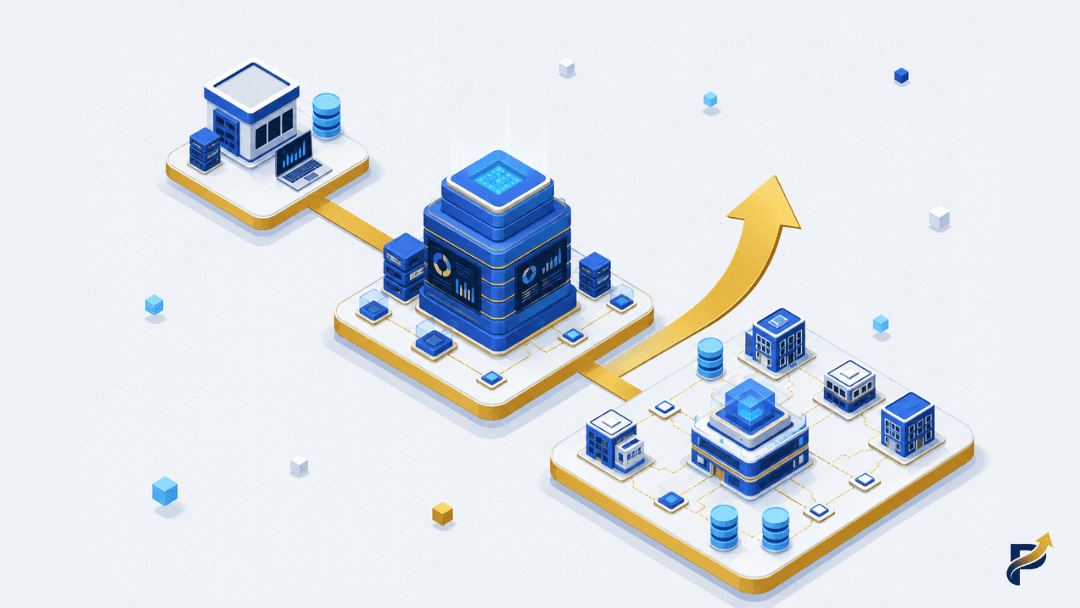
Why Single-Tenant Consolidation Is Now Non-Negotiable for Finance Leaders
For years, the conventional wisdom was to let each subsidiary manage its own ERP instance. It felt safer. Less disruptive. Each local finance team knew their system, their chart of accounts, their month-end process. But that thinking has quietly created an enormous operational debt.
Consider what "system sprawl" actually costs your business. Each separate ERP instance carries its own licensing fee, its own upgrade cycle, its own support contract, and its own dedicated administrator. Multiply that by four or five subsidiaries and you're burning budget on redundancy — paying four times to solve the same accounting problem. Industry research consistently shows that organisations running fragmented ERP landscapes spend significantly more per finance transaction than those on consolidated platforms, and the gap is widening as cloud-native systems grow more capable.
The pressure on finance leaders has intensified sharply. According to industry research from October 2025, CFOs are facing mounting board-level expectations to consolidate fragmented ERP systems — not as a future roadmap item, but as an active priority. The reason is simple: fragmented data means fragmented decisions. When your Singapore subsidiary closes on a different timeline than your UK operation, and neither feeds automatically into your group consolidation tool, strategic decisions get made on stale data.
Here's the counter-intuitive part that most consultants won't tell you: the biggest risk in multi-entity consolidation isn't the technology. Modern cloud ERP platforms have largely solved the technical problem. Microsoft Dynamics 365 was named a Leader in three separate Gartner Magic Quadrant categories in 2025 — Cloud ERP for Service-Centric Enterprises, Cloud ERP for Product-Centric Enterprises, and Cloud ERP Finance — precisely because its native multi-entity capabilities have matured dramatically. Oracle NetSuite, SAP S/4HANA, and Acumatica have all followed a similar path.
The real risk is change management and cutover sequencing — how you move each operating company onto the new tenant without freezing operations. That's the problem this article is designed to help you solve.
A PapaSiddhi perspective worth noting: in our experience supporting multi-entity migrations across APAC, the Middle East, and North America, the organisations that struggle most are not the ones with the most complex subsidiaries. They're the ones that tried to solve the chart-of-accounts harmonisation problem and the go-live sequence problem simultaneously, without a disciplined framework for separating what must be standardised from what can stay local.
The Consolidation Decision Framework: What to Standardise and What to Leave Alone
This is the question that causes more delayed projects than any technical barrier. Finance directors want to standardise everything; subsidiary general managers want to change nothing. The truth — as always — sits in the middle, and getting this balance right determines whether your consolidation succeeds or stalls.
Here's a practical framework based on real-world multi-entity ERP migrations:
| Element | Must Standardise | Can Remain Local | Notes |
|---|---|---|---|
| Chart of Accounts (Group Level) | ✅ Core account codes | Local sub-accounts allowed | Group segments must map cleanly |
| Intercompany Transaction Codes | ✅ Fully standardised | None | Essential for automated eliminations |
| Currency & Exchange Rate Policy | ✅ Group base currency required | Local functional currency stays | Multi-currency handled natively in D365, NetSuite |
| Financial Period / Close Calendar | ✅ Group close dates fixed | Local operational periods flexible | Prevents midnight-Sunday reconciliation |
| Tax & Regulatory Reporting | ❌ Do not over-standardise | Managed locally with group visibility | VAT, GST, withholding tax vary by jurisdiction |
| Approval Workflows | Recommended standard | Department-level flexibility fine | Reduces audit complexity significantly |
The most critical element on that table is the chart of accounts harmonisation. Think of the chart of accounts as the shared language your subsidiaries use to report financial activity. If Singapore calls sales revenue "4100" and your UK subsidiary calls it "7200-REV," your group consolidation tool has to manually translate between the two every single month. That translation work is where errors, delays, and audit risk accumulate.
What you need is a group segment structure — a master set of account codes at the group level that every subsidiary maps to, while retaining the ability to add local sub-accounts beneath that structure for their own operational reporting. Modern platforms like Dynamics 365 Business Central support this through dimensional account structures, where local entities can extend the chart without breaking the group hierarchy.
Intercompany transaction codes, on the other hand, cannot be left to local discretion. When Entity A in Dubai sells services to Entity B in Toronto, both sides of that transaction must be coded identically so that the platform can automatically eliminate the intercompany balance during consolidation. If those codes drift, your elimination entries become manual, your close cycle extends, and your auditors get nervous.
A forward-looking prediction for 2027: AI-assisted chart-of-accounts mapping — where the platform analyses historical transaction data from legacy systems and proposes harmonised account mappings automatically — will become standard in major cloud ERP platforms. Early versions exist today, but by 2027 they'll be accurate enough to reduce harmonisation design time by roughly 60%.
The Numbers Behind the Business Case
Before we get to the practical migration sequence, let's ground this in the commercial reality. Because if you're a CEO or CFO reading this, you need to walk into a board meeting with numbers — not just a technology narrative.
Industry research across mid-market enterprises consistently shows that organisations running multiple ERP instances spend between 25% and 40% more on total finance operations cost per transaction compared to those on a single consolidated platform. That gap comes from redundant licensing, duplicated administrative overhead, and the hidden cost of manual reconciliation work that your finance team is absorbing every reporting cycle.
Microsoft's Dynamics 365 platform and comparable platforms demonstrate that native multi-entity management — including intercompany eliminations, multi-currency consolidation, and unified financial reporting — is now available out-of-the-box, without the custom development that made single-tenant consolidation so expensive a decade ago. That changes the ROI calculation fundamentally.
Consider a real-world scenario: a manufacturing group with subsidiaries in three countries, each running a separate ERP instance, might be paying licensing and support for three systems, employing three part-time system administrators, and spending 8–12 days per month on manual intercompany reconciliation. Consolidating onto a single tenant typically eliminates two of those three license costs, reduces admin overhead by 60–70%, and compresses that reconciliation cycle to near-zero — because the platform handles elimination entries automatically.
For growing companies, the analytics gain is arguably more valuable than the cost saving. When all your entities report into a single data model in real time, your CFO can see group-wide cash position, aged receivables, and gross margin by entity at any moment — not just at month-end. Strategic decisions that used to wait for a 10-day close cycle can now happen continuously.
APQC's benchmarking research confirms a persistent gap between organisations that have achieved this consolidated state and those still running fragmented instances, with the top-performing quartile closing their books significantly faster — in some cases reducing financial close cycles from 10 or more days to under 5. The Gartner Peer Insights community has seen a sharp increase in reviews specifically citing multi-entity capability as a primary ERP selection criterion in 2025, signalling that the market has already moved to treating this as table stakes rather than a premium feature.
Even if your organisation doesn't have a dedicated IT team, the cost case for consolidation typically pays back within 18–24 months. You don't need a huge budget to start — a well-structured phased migration can be designed to generate savings from the first entity cutover, funding subsequent phases from operational cost reduction.
The Entity-by-Entity Cutover Sequence: Moving Without Stopping
This is where consolidation projects succeed or fail. The technical architecture can be perfectly designed, but if your cutover sequence is wrong, you'll disrupt operations, damage relationships with subsidiary management, and undermine trust in the entire programme.
Here's the sequencing approach that consistently works in practice:
Phase 1: Configure and validate the group tenant before touching any live entity. Stand up your single tenant, load the harmonised chart of accounts, configure intercompany rules, and run six months of historical data from your first target entity through it. Validate that eliminations work correctly, that currency revaluations produce expected results, and that your group reporting pack matches what the legacy system produced. This is your quality gate — nothing moves to production until this passes.
Phase 2: Run parallel systems through exactly one full reporting cycle. This is the non-negotiable safety net. For your first entity cutover, both the legacy ERP and the new tenant process real transactions simultaneously for one full month-end close. Your finance team reconciles the outputs. If they match, you proceed. If they don't, you investigate before going live. Yes, this doubles workload for that month — but it's the only way to catch configuration errors before they affect your audited financials.
Phase 3: Sequence entities by complexity, not by size. A counter-intuitive but important principle: don't start with your largest subsidiary because it feels like the biggest prize. Start with your simplest entity — fewest transaction types, smallest team, least regulatory complexity. Use that first cutover to validate your migration methodology and build your team's confidence. Then tackle progressively more complex entities.
Phase 4: Define a clear "frozen period" for each entity. Typically 3–5 business days before and after the entity's go-live date, no new system changes are deployed, no chart-of-accounts amendments are made, and the migration team is on full standby. Think of it like a surgical procedure — you want a clean, controlled environment, not one where someone is patching the operating room while the patient is on the table.
Critically, each entity keeps its local functional currency and local tax configuration throughout. The consolidation happens at the reporting layer, not the operational layer. Your Tokyo subsidiary still operates in JPY, issues invoices in JPY, and files Japanese tax returns. The platform converts and consolidates at the group level automatically. This is what makes the "what stays local" question so important — operational flexibility at the entity level is preserved precisely because the standardisation happens in the right places.
How PapaSiddhi Can Help
Executing a multi-entity ERP consolidation without halting operations requires three things working in parallel: deep platform expertise, a disciplined migration methodology, and enough skilled capacity to run parallel environments without burning out your internal team.
That's exactly what PapaSiddhi Technologies delivers through our IT Outsourcing services and dedicated Business Central and Dynamics 365 practice. Our team includes certified ERP architects, chart-of-accounts design specialists, intercompany configuration experts, and finance process consultants — all available to embed directly in your project.
For global organisations, we support consolidation programmes across APAC, the Middle East, UK, and North American markets, with experience navigating the local regulatory nuances that make entity-by-entity sequencing complex. You can hire dedicated ERP developers with domain expertise in multi-entity configurations — onboarded within 48 hours, backed by our free replacement guarantee if the fit isn't right.
You don't need to build an internal team from scratch to run this programme. Even smaller business groups with limited IT capacity can execute a structured consolidation with the right external partner. Talk to our team — we offer a free consultation to assess your current ERP landscape and recommend a consolidation sequence that keeps your operations running throughout.
Conclusion
Multi-entity ERP consolidating subsidiaries onto a single tenant is genuinely achievable without halting operations — but only if the design decisions are made in the right order. Standardise where it creates group-level clarity: the chart of accounts core structure, intercompany transaction codes, and your close calendar. Leave operational flexibility where it belongs: local currencies, tax configurations, and departmental workflows.
Sequence your entity cutovers from simplest to most complex, run one full parallel reporting cycle before decommissioning any legacy system, and define clean frozen periods around each go-live. The technology is ready. The platforms are mature. The remaining challenge is execution discipline — and that's a solvable problem.
Frequently Asked Questions
Common questions about multientity erp consolidating subsidiaries answered by the PapaSiddhi expert team.