 USA
USA UK
UK AU
AU UAE
UAE India Dev Centre
For years, AI implementation for small business felt like a luxury reserved for tech giants with unlimited R&D budgets. That perception is now obsolete. In 2026, artificial intelligence is more accessible, more affordable, and more impactful for small and medium businesses (SMBs) than at any point in history — provided you know where to start and what to avoid.
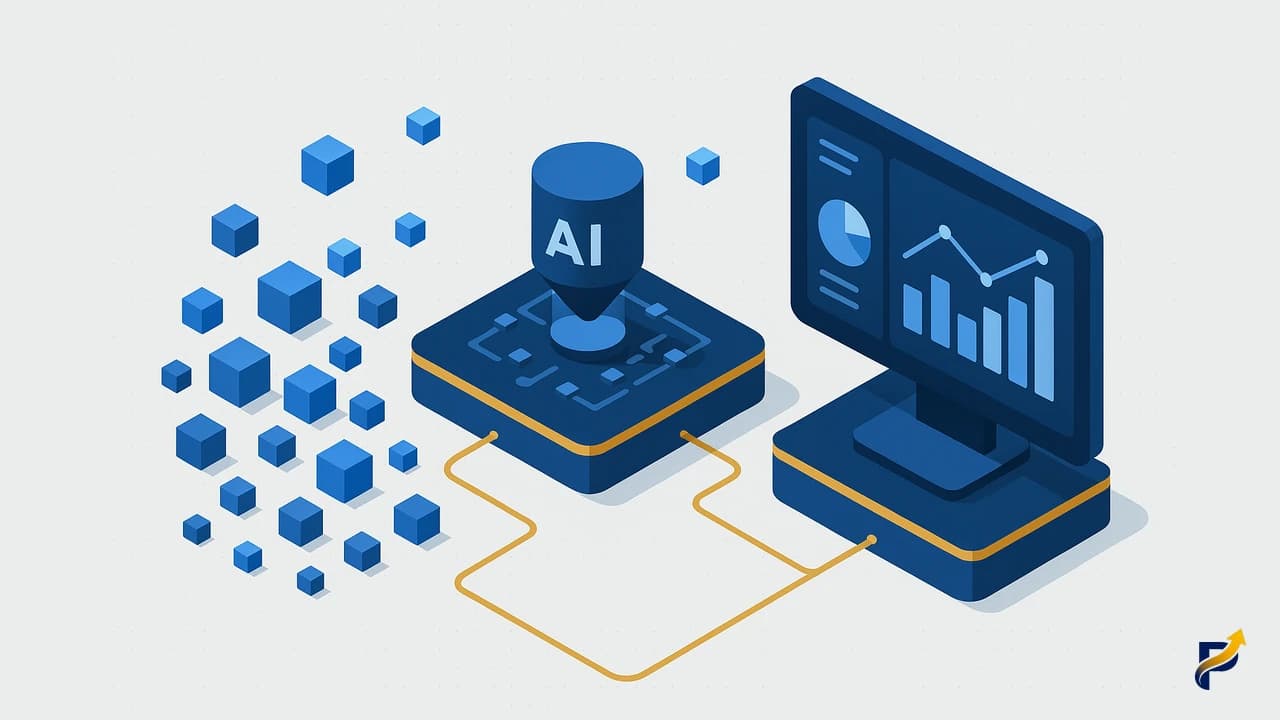
As a Power BI and Data Analytics Specialist with over seven years of experience working with businesses across India, the UK, the UAE, and beyond, I've watched the conversation around AI shift from "should we explore this?" to "how quickly can we implement this?". The SMBs that are asking the second question are already pulling ahead of their competitors.
This guide is built for business decision-makers who want a grounded, honest, and practical roadmap — not vendor hype.
Why AI Is Now Within Reach for SMBs
The economics of AI have fundamentally changed. According to McKinsey's State of AI 2025 report, 88% of organisations now report using AI in at least one business function — up ten percentage points on the prior year — and generative AI adoption alone has climbed to 79%. Tellingly, McKinsey also found that only around one-third of organisations have scaled AI beyond pilots, which is precisely where disciplined SMBs can move faster than larger, slower competitors. Meanwhile, Grand View Research and other market analysts project the global AI market to approach $1.8 trillion by 2030, with SMB-focused SaaS and API-driven tools accounting for a rapidly increasing share of that growth.
Three forces have made this possible:
- 1Cloud infrastructure has eliminated the need for on-premise hardware investment.
- 2Pre-trained models and AI APIs (like OpenAI, Google Vertex AI, and Azure AI Services) allow businesses to consume intelligence without building it from scratch.
- 3No-code and low-code platforms have reduced the technical barrier so that a business analyst — not just a data scientist — can deploy meaningful AI workflows.
The Real Barriers to AI Adoption (And How to Overcome Them)
Problem: "We Don't Have Clean Data"
This is the single most common concern I hear from SMB owners, and it's legitimate. AI models are only as good as the data fed into them. Many small businesses operate with data scattered across spreadsheets, legacy CRMs, and disconnected tools.
Solution: Before any AI project begins, audit your data landscape. Identify your three to five most critical data sources — sales records, customer interactions, inventory logs — and assess their completeness and consistency. You don't need perfect data to start; you need sufficient data in the right areas.
Investing in a solid data foundation — whether through a Power BI development engagement or a structured data pipeline — pays dividends across every AI initiative that follows. Data readiness is not a blocker; it's your first deliverable.
Result: Businesses that invest 4–6 weeks in data preparation before AI deployment report up to 40% higher model accuracy and significantly shorter iteration cycles, based on implementation patterns observed across multiple client engagements.
Problem: "AI Feels Too Complex and Expensive"
This concern is rooted in an outdated mental model of AI — one that involves massive compute clusters, PhD-level teams, and multi-year timelines.
Solution: Modern AI implementation for small business follows a modular, phased approach. You don't boil the ocean. You identify a single high-value use case — say, automating customer support triage, predicting inventory demand, or generating sales forecasts — and build a proof of concept within 4–8 weeks.
Platforms like Microsoft Azure AI, Power Automate with AI Builder, and pre-built ML models through cloud providers allow rapid prototyping without enormous upfront costs. Licensing costs for AI capabilities embedded in Microsoft 365 Business Premium, for example, start at levels well within SMB budgets.
For businesses that need custom AI solutions but lack in-house engineering capacity, AI & ML development services from a specialist outsourcing partner can compress timelines and reduce cost significantly compared to building an internal team.
Result: A well-scoped AI pilot for an SMB can be completed for between $8,000 and $25,000 USD — a fraction of what enterprise implementations cost five years ago. ROI timelines of 6–12 months are increasingly common for targeted automation projects.
Problem: "We Don't Know Where AI Will Actually Help Us"
Decision-makers often understand that AI is important, but struggle to translate that into concrete internal use cases. This uncertainty leads to paralysis or, worse, implementing AI for the wrong processes.
Solution: Use a value-impact matrix. Map your business processes on two axes: the volume of repetitive manual effort involved, and the business value of getting that process right. High on both axes? That's your first AI use case.
Common high-impact areas for SMBs include:
- ▸Customer service: AI-powered chatbots and ticket routing
- ▸Finance: Automated invoice processing and anomaly detection in accounts payable
- ▸Sales: Lead scoring and churn prediction
- ▸Operations: Demand forecasting and supply chain optimisation
- ▸HR: CV screening and onboarding automation
- ▸Marketing: Content personalisation and campaign performance prediction
A Practical AI Implementation Roadmap for SMBs
Here is a phased framework that we at PapaSiddhi Technologies have refined through real-world engagements with clients across the UK, UAE, and Australia. Based out of Udaipur, India, our team has seen firsthand what separates AI projects that deliver ROI from those that stall.
Phase 1: Assess (Weeks 1–2)
- ▸Audit existing data sources and quality
- ▸Identify and prioritise two to three high-impact use cases
- ▸Define measurable success metrics (not vanity metrics)
- ▸Assess current technology stack compatibility
Phase 2: Pilot (Weeks 3–8)
- ▸Select one use case for a focused proof of concept
- ▸Choose appropriate tooling: pre-built AI APIs, low-code platforms, or custom model development depending on complexity
- ▸Build and test with a representative sample of real business data
- ▸Document findings, accuracy rates, and integration considerations
Phase 3: Deploy (Weeks 9–14)
- ▸Integrate the validated model into live business workflows
- ▸Train relevant team members on interaction and oversight
- ▸Establish monitoring dashboards to track model performance over time
- ▸Begin measuring against the success metrics defined in Phase 1
Phase 4: Scale (Month 4 Onwards)
- ▸Apply learnings from the pilot to additional use cases
- ▸Explore deeper integrations with core business systems such as ERP, CRM, and document management
- ▸Build internal AI literacy across departments
- ▸Review ROI quarterly and adjust model parameters as business conditions evolve
Choosing the Right AI Tools for Your SMB
Not every AI tool is appropriate for every business context. Here is a concise framework for tool selection:
| Use Case | Recommended Approach | Example Tools |
|---|---|---|
| Data analytics and forecasting | BI-integrated AI | Power BI AI visuals, Azure ML |
| Customer support automation | Pre-built NLP APIs | Azure Bot Service, Dialogflow |
| Document processing | Cognitive services | Azure Form Recognizer, AWS Textract |
| Custom predictive models | Custom ML development | Python/TensorFlow, Azure ML Studio |
| Workflow automation | Low-code AI builders | Power Automate AI Builder, Zapier AI |
The critical principle: match tool complexity to problem complexity. Over-engineering an AI solution is as costly as under-investing in it.
The Human Element: Change Management in AI Adoption
One of the most underestimated factors in AI implementation for small business is the human dimension. Technology deployment rarely fails because of the technology itself — it fails because of inadequate change management.
Employees who feel that AI is being imposed on them, rather than introduced to empower them, become the single biggest obstacle to adoption. Decision-makers must communicate clearly:
- ▸What the AI system does and does not do
- ▸Why it is being implemented (efficiency gains, not workforce reduction, in most SMB contexts)
- ▸How it will change day-to-day workflows
- ▸Who is responsible for monitoring and refining the system
Measuring AI ROI: Metrics That Matter
AI is not free, and decision-makers are right to demand accountability. The following metrics provide a structured view of AI performance for SMBs:
- ▸Process time reduction: How many hours per week are saved on the targeted workflow?
- ▸Error rate reduction: What is the before/after comparison on quality metrics?
- ▸Revenue impact: Has lead conversion, customer retention, or average order value improved?
- ▸Cost per transaction: Has the unit cost of processing invoices, support tickets, or data entries decreased?
- ▸Employee productivity: Are your people spending more time on high-value tasks?
Working with an AI Implementation Partner
Many SMBs lack the in-house capability to execute AI projects end to end. This is not a weakness — it's a practical reality that an external partner can address efficiently.
When evaluating an AI development partner, look for:
- ▸Demonstrated experience with SMB-scale projects (not just enterprise case studies)
- ▸Capability across data engineering, model development, and integration
- ▸Transparent pricing and phased engagement models
- ▸Post-deployment support commitments
- ▸Strong communication practices, especially if working across time zones
For organisations exploring the option of embedded AI expertise, you can also hire remote AI and data developers on a flexible basis — an increasingly popular model for SMBs that want dedicated capability without long-term overhead.
Key Takeaways for Decision-Makers
- ▸AI implementation for small business is no longer a future consideration — it is a present competitive differentiator.
- ▸Start with data readiness and a single, high-value use case rather than a broad AI strategy.
- ▸Phase your implementation: assess, pilot, deploy, scale.
- ▸Invest in change management alongside technology deployment.
- ▸Measure ROI rigorously from day one using process, quality, and financial metrics.
- ▸Choose implementation partners with proven SMB experience and transparent engagement models.
Sources: McKinsey, The State of AI 2025; Grand View Research, Artificial Intelligence Market Report; Microsoft Azure AI Services Documentation.
Explore AI & ML Development Services at PapaSiddhi | Contact our team to discuss your AI readiness
Frequently Asked Questions
Common questions about ai implementation small business answered by the PapaSiddhi expert team.