Healthcare
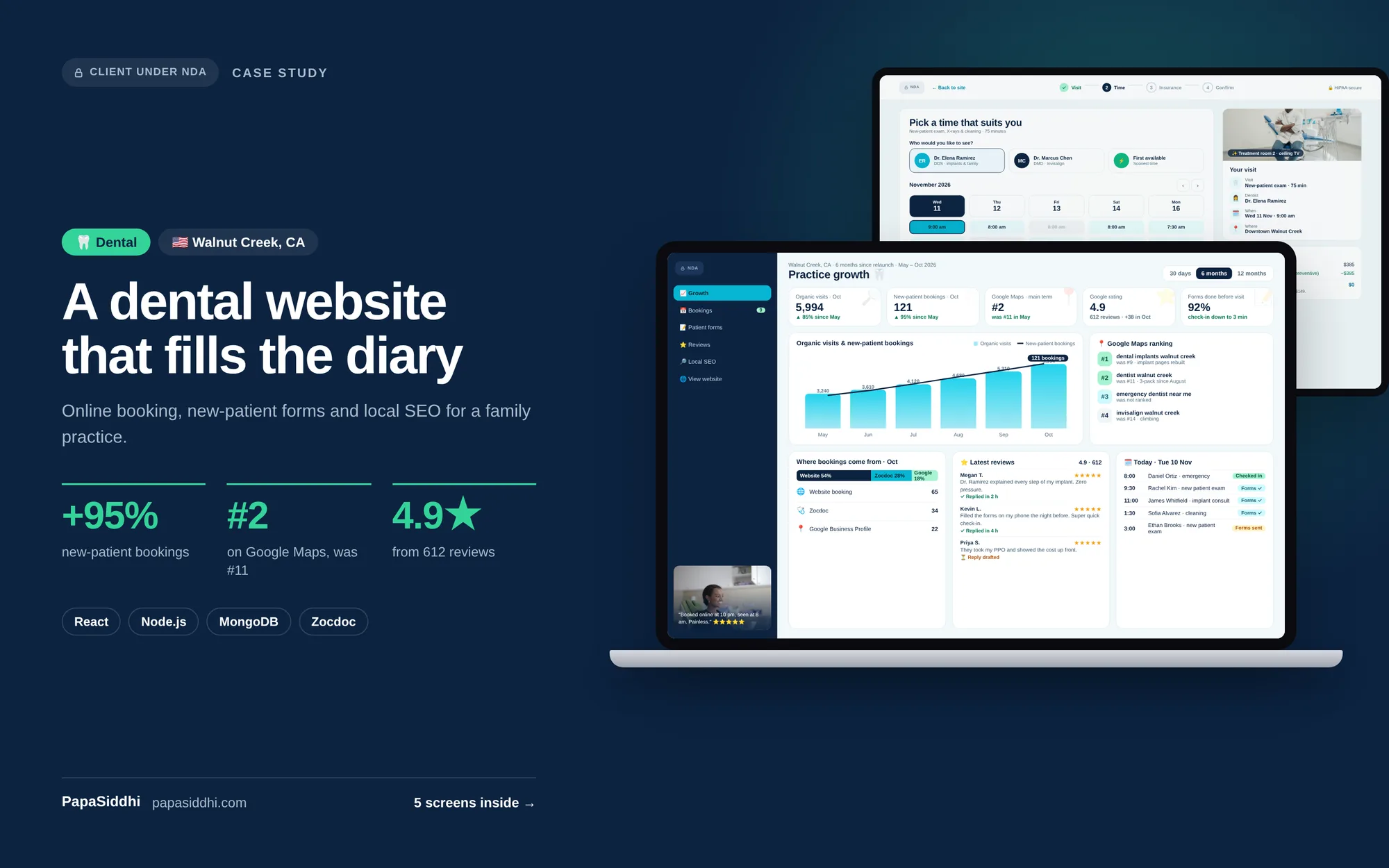
Patient Acquisition Website for Dental Practice, USA
Increased organic website traffic by 85% and new patient bookings by 95% within six months.
ReactNode.jsMongoDB
United States·Business WebsiteView Study →
A HIPAA-compliant clinical decision support web application helping healthcare providers convert patient history (Hx) into optimized treatment prescriptions (Rx) — improving clinical efficiency and reducing prescription errors.
Reduced clinical decision time by 40% and demonstrated measurable reduction in prescription errors in pilot deployments.
Project Highlights
Scalable Architecture
Built for growth — Medical Web App designed to scale
Secure & Compliant
Enterprise-grade security and data protection standards
Measurable ROI
Manual clinical review → AI-assisted decision support
United States Delivery
Delivered for a United States-based Healthcare client
Tech Stack
Last updated:
Industry
Healthcare
Sector
Medical Technology
Region
United States
Project Type
Medical Web App
The client operates in the United States healthcare sector, building medical technology for providers who treat patients across outpatient and clinical settings. Its focus is the point of care, where clinicians must interpret patient history, current medications and clinical guidelines quickly before deciding on a treatment plan and writing a prescription. The client's customers range from smaller practices to larger provider groups.
In American healthcare, clinician time is one of the scarcest resources, and prescription errors carry serious consequences for patient safety, liability and cost. Any software touching patient data must also respect HIPAA privacy and security requirements. The client wanted a decision support application that would help providers move from history (Hx) to prescription (Rx) more efficiently and safely, without adding administrative burden.
This project was delivered under a Non-Disclosure Agreement. The client operates in the Healthcare sector (Medical Technology) and is based in United States. More on how we work with US companies.
Providers were spending excessive time manually reviewing patient history to formulate treatment plans. Relevant details were spread across notes, medication lists and prior encounters, and cross-checking them against clinical guidelines and drug interaction references was done largely from memory or separate lookup tools. This slowed consultations and reduced the time available for direct patient care.
Manual review also created room for error. Contraindications and interactions could be missed under time pressure, and there was no consistent record of how a treatment decision had been reached. Technically, any solution had to handle protected health information securely, keep a full audit trail, and be architected to connect with electronic health record systems used by US practices rather than becoming another isolated application.
Manual clinical review
AI-assisted decision support
PapaSiddhi developed a secure clinical decision support web application with a React interface designed for fast clinical workflows, a Node.js backend running the analysis logic and a PostgreSQL database for structured clinical data. The application was built with HIPAA requirements in mind, including access controls, encrypted data handling and a complete audit trail with clinical documentation.
A clinical history input and analysis engine structures the patient's history and feeds an evidence-based treatment recommendation system that suggests suitable protocols aligned with clinical guidelines. Integration with the FDA drug database powers drug interaction and contraindication alerts, so potential conflicts are flagged before a prescription is finalised. Recommendations are presented as guidance for the clinician to accept, adjust or reject, keeping professional judgement firmly in control.
The platform uses an EHR integration-ready API architecture, allowing it to connect with electronic health record systems through EHR APIs. The solution was validated through pilot deployments with healthcare providers, whose feedback shaped the recommendation display and alerting behaviour before wider rollout. Because the platform was built for United States providers, the interface follows familiar clinical terminology and is designed to fit within short appointment slots rather than lengthening them.
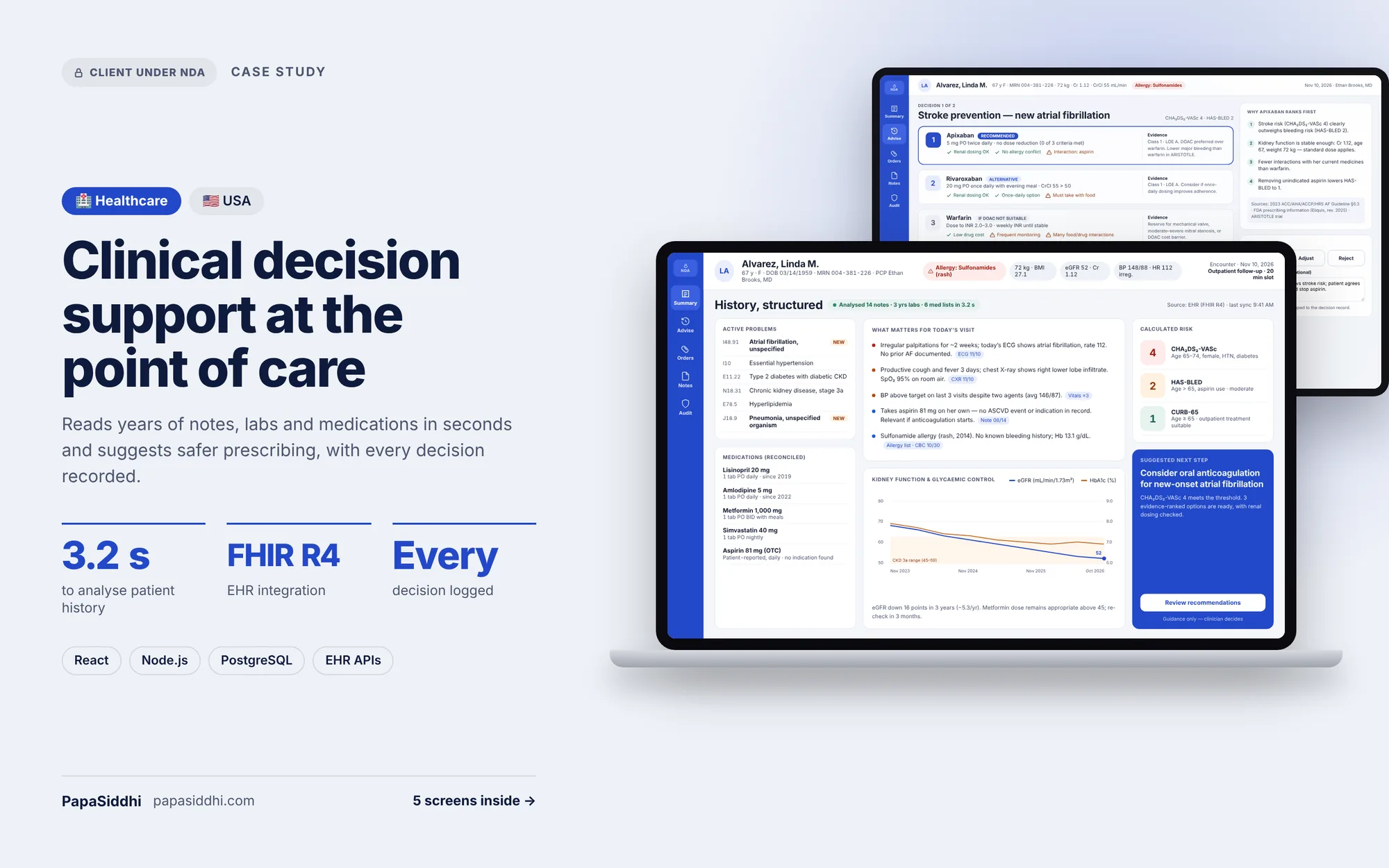
Reduced clinical decision time by 40% and demonstrated measurable reduction in prescription errors in pilot deployments. Healthcare providers reported significantly improved confidence in treatment protocol selection.
Transformation Summary
Manual clinical review → AI-assisted decision support
This project was delivered under a Non-Disclosure Agreement (NDA). Specific client details, business data, proprietary workflows, and project credentials remain confidential. Screenshots and live URLs are available upon mutual NDA execution.
Request an NDA to see full detailsWe build to HIPAA technical safeguards — encryption in transit and at rest, role-based access, audit logging and minimum necessary access — and will sign a business associate agreement where we handle protected health information. HIPAA compliance is an organisational posture rather than a certificate a vendor can grant you, and we are careful not to imply otherwise.
It can be, depending on what the tool does and whether it meets the clinical decision support exemption criteria under the 21st Century Cures Act. That determination is a regulatory question for you and your counsel, not a technical one — we build to support whichever path applies, but we will not make that call for you.
Through EHR APIs, with the specifics depending heavily on which system you use and what your vendor exposes. This is usually the longest pole in a clinical project and we scope it explicitly rather than assuming, because EHR integration effort varies enormously between vendors.
The clinician is, and the system is deliberately designed to support that rather than obscure it — it suggests protocols against clinical guidelines and drug interaction data, with the reasoning visible so a provider can evaluate the recommendation. Any tool that positions itself as replacing clinical judgement creates liability and adoption problems in equal measure.
Those figures came from pilot deployments, and we would present them as such rather than as guaranteed outcomes. Results depend on your existing workflow and how much manual history review it currently involves — the gain is largest where clinicians are assembling context from multiple systems by hand.
Let's discuss your project and create a success story together.
Healthcare
Increased organic website traffic by 85% and new patient bookings by 95% within six months.
Healthcare
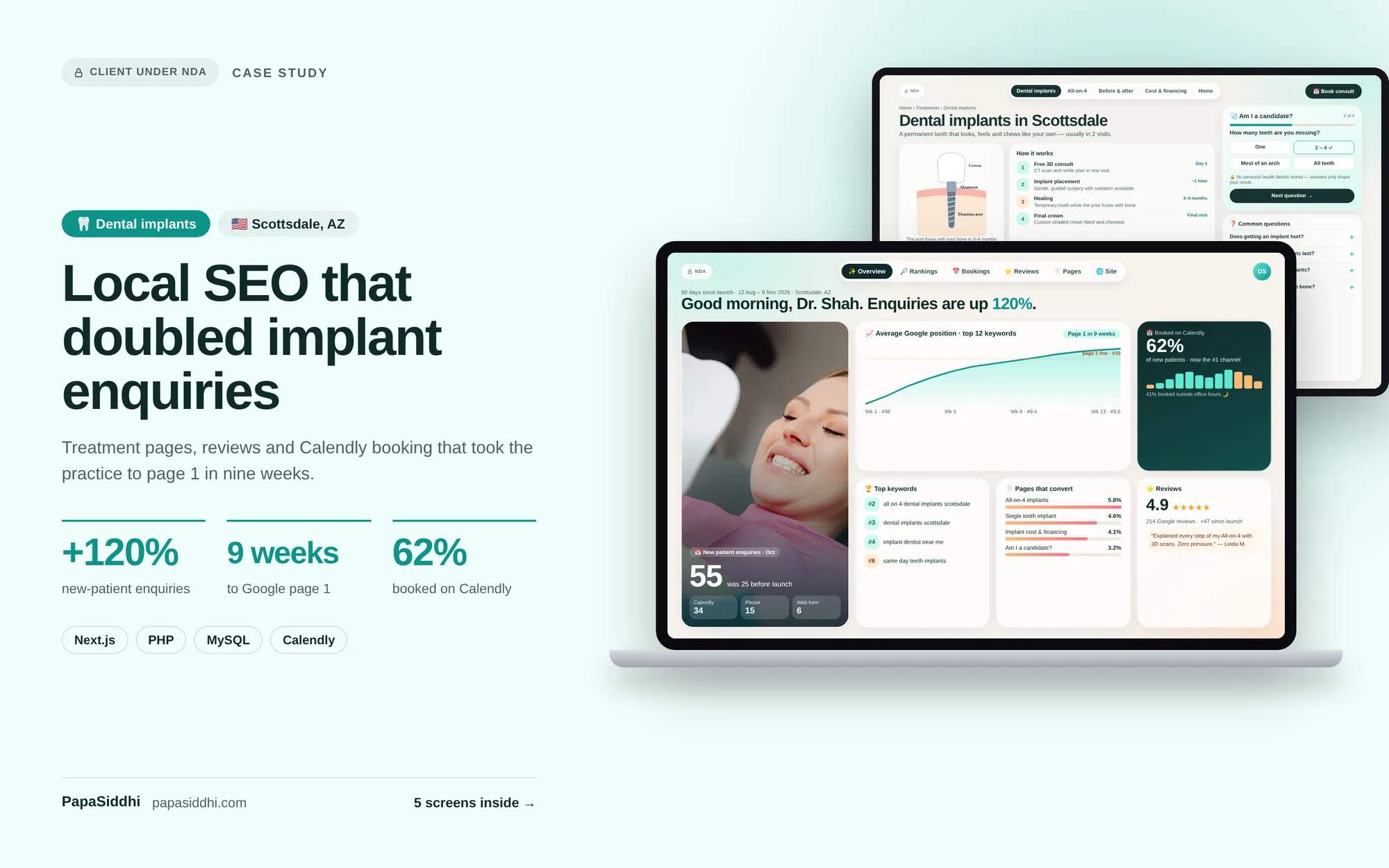
Achieved page 1 Google rankings for key local dental keywords within 90 days.
Healthcare
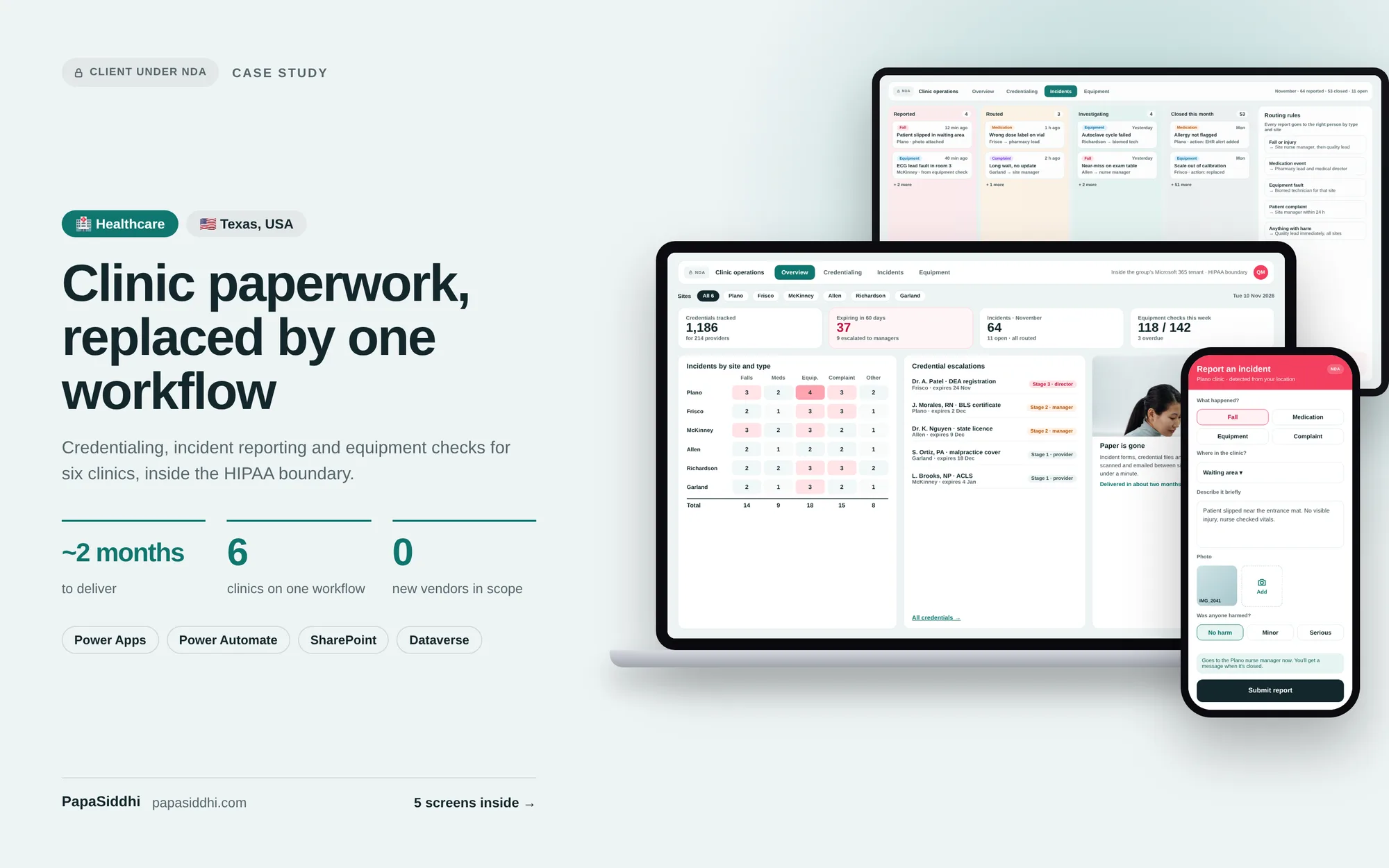
Delivered in approximately two months by a small dedicated team, the shortest project in this set because building on an existing platform avoided most of the infrastructure work.