 USA
USA UK
UK AU
AU UAE
UAE India Dev Centre
Most operators building a custom transport management system make the same expensive mistake: they start with the feature they want rather than the one they need. They budget for AI-powered route optimisation before their dispatchers can even see where their vehicles are. The result is a six-figure system the team doesn't trust, doesn't use consistently and can't maintain. If you run between 20 and 80 vehicles and are seriously considering a custom TMS in 2026, this guide is written for you.
Key Takeaways
- ▸Off-the-shelf TMS products are strong at carrier management and freight audit, but mid-sized fleet operators often outgrow them on dispatch logic, proof of delivery and integration.
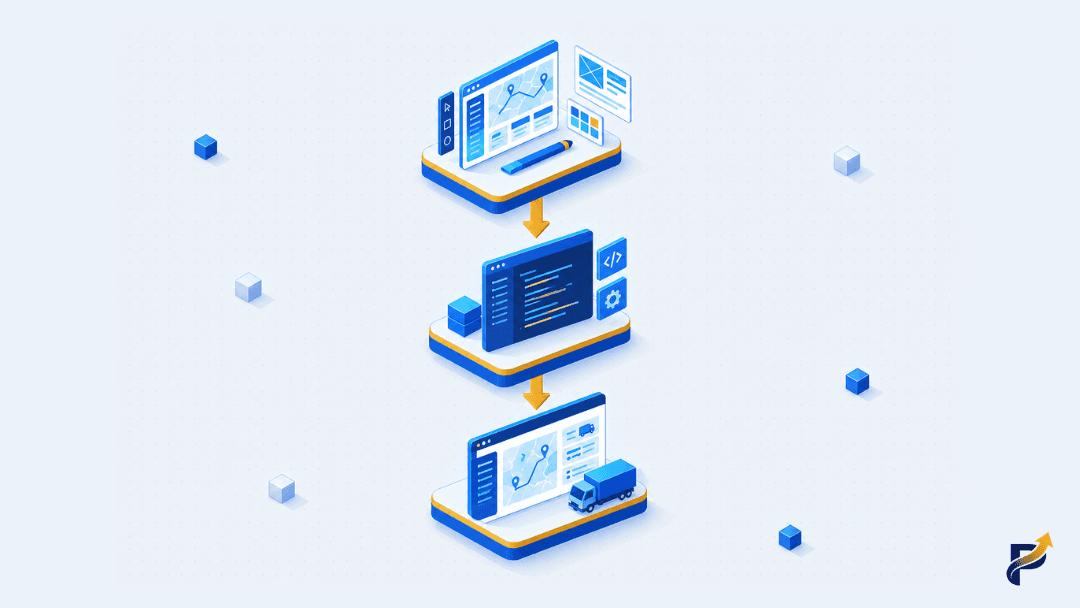
- ▸Build in this order: dispatch and job allocation, driver mobile app, ePOD, ERP/WMS integration, then route optimisation and customer portals.
- ▸Decide early on cloud-native hosting, API-first design and job-level emissions data. These choices are expensive to reverse.
- ▸Emissions reporting is converging on ISO 14083, and the EU's CountEmissionsEU framework uses it as the common method.
- ▸Arrive at your first developer meeting with a mapped workflow, a systems list and a view of your data quality.
Why Off-the-Shelf TMS Products Keep Failing Mid-Sized Operators
Off-the-shelf TMS platforms do several things well. Products like Oracle Transportation Management, SAP TM, Alpega and Descartes handle carrier rate management, freight audit and high-volume load tendering with real sophistication. If your main challenge is managing dozens of third-party carriers and thousands of freight invoices, a packaged product is probably the right call.
But transport operators running their own fleets consistently hit walls in three areas.
First, job allocation and dispatch workflows. Every fleet has its own logic for assigning jobs: by driver skill, vehicle type, proximity, customer priority, shift pattern or a combination of all five. Packaged systems impose their own workflow assumptions, and customising them can cost more than building the module yourself.
Second, proof of delivery capture. The moment you need something specific, such as a photo of a damaged pallet, a temperature reading at delivery or a signature linked to a specific order line, packaged systems start to creak. You end up paying for integrations that half-work, or drivers juggling two apps.
Third, integration with existing business systems. Most mid-sized operators already run an ERP (accounting and business management) and often a WMS (warehouse management). Generic connectors frequently leave someone reconciling data by hand every week. Our guide to WMS, TMS and ERP integration patterns explains why this happens and how to avoid it.
The build-vs-buy decision isn't purely technical. Many larger operators now layer custom modules on top of a packaged core. For operators of 20 to 80 vehicles with distinctive workflows, a purpose-built system is often the better long-term fit, provided it is built in the right order. For a full cost comparison, see our five-year total cost of ownership breakdown.
The Realistic Build Sequence: What to Build First and Why
Here's the counter-intuitive truth: route optimisation should not be your first module. It feels like the big win and it's what gets board approval, but operators who start there routinely rebuild dispatch a year later.
This is the sequence that works for a 20–80 vehicle operator. Timelines are indicative and depend on scope and team size.
| Build Phase | Module | Primary Benefit | Indicative Timeline | Relative Budget |
|---|---|---|---|---|
| Phase 1 | Dispatch & job allocation | Replaces whiteboard and spreadsheet workflows | 8–12 weeks | £££ foundation |
| Phase 2 | Driver mobile app & job capture | Real-time job status for the operations team | 6–10 weeks | ££ high value |
| Phase 3 | Electronic proof of delivery (ePOD) | Removes paper and speeds up invoicing | 6–8 weeks | ££ fast payback |
| Phase 4 | ERP/WMS integration | Removes double entry, one source of truth | 8–14 weeks | £££ critical enabler |
| Phase 5 | Route optimisation | Fewer miles and better on-time performance | 10–16 weeks | ££££ strategic |
| Phase 6 | Customer portal & reporting | Fewer "where is my delivery" calls | 6–10 weeks | ££ differentiator |
Start with dispatch and job allocation because it's the operational heartbeat of the business. Everything else depends on jobs being created, assigned and tracked reliably. Get this right and your drivers know what they're doing, your dispatchers have one system they trust, and your data is clean enough to power everything that follows.
The driver mobile app comes second because it creates your real-time data pipeline: the live feed of job status updates that makes everything downstream possible. Without it, you're still phoning drivers to find out where a vehicle is. A cross-platform framework such as Flutter lets one codebase serve both Android and iOS devices, which keeps build and maintenance costs down.
ePOD comes third, and this is where finance sees the return. With digital proof of delivery, invoices can go out as soon as the job closes instead of waiting for paperwork to come back to the office. On a business turning over a few million pounds a year, a shorter invoice cycle is a real working capital improvement.
The 2026 Architecture Decisions That Will Save or Cost You
These decisions are made early and are expensive to reverse, even if you never plan to manage the system yourself.
Cloud-native hosting is now the baseline. Your system runs on AWS, Google Cloud or Microsoft Azure rather than a server in your office, so it scales from 40 to 120 vehicles without a hardware project. Our cloud solutions team can advise on the right setup.
API-first design is equally critical. An API (Application Programming Interface) is a standard way for software systems to talk to each other. Building API-first means that connecting a new carrier network, fuel card provider or telematics platform doesn't need a bespoke project every time.
Emissions data from day one. Customers increasingly ask carriers for shipment-level emissions figures. The international method for this is ISO 14083:2023, which covers greenhouse gas emissions from transport chain operations. The EU has also adopted the CountEmissionsEU framework (Regulation (EU) 2026/1030), which aligns with ISO 14083 and sets a common method for companies that choose to disclose transport emissions. In practice, your TMS should record distance, vehicle type, fuel type and load at job level, not just as monthly totals. Retrofitting this later is far more expensive than building it in.
Route optimisation, when you're ready. Optimised routing can reduce mileage and fuel use, but the size of the saving depends on your network, job density and how good your current planning is. Measure your baseline mileage and on-time performance first, so you can prove the return rather than relying on vendor claims. Our AI and ML development team builds optimisation on top of clean job data.
A forward-looking note: we expect predictive exception management, meaning systems that flag a likely late delivery before it happens rather than after, to become a standard request from larger shippers. Operators who capture clean, timestamped job events now will be well placed to add it.
What to Sort Out Before Your First Developer Meeting
Too many operators arrive at their first planning session without the information developers actually need. That delays projects by weeks and inflates scope.
Before any technical conversation, get clear on five things:
- 1Map your dispatch workflow in plain language. Walk through a typical job from creation to invoice. Where are the handoffs? Where does information get lost? Where do dispatchers spend most of their time firefighting?
- 2List your existing systems. Which ERP do you run: Sage, Business Central, Xero or something else? Which WMS? Which telematics platform supplies vehicle locations? Your developers need this list on day one to plan ERP integration properly.
- 3Identify your most expensive manual processes. Talk to your operations manager, not just your IT lead. The tasks that consume the most staff time are usually where a custom module pays back fastest.
- 4Define what "real-time" means for you. Do you need vehicle locations every 30 seconds, or is every 5 minutes enough? The answer affects infrastructure costs.
- 5Check your data quality. If job records are inconsistent, addresses are unstructured or the customer list has duplicates, fix that before you build. Optimisation algorithms are only as good as the data feeding them.
You don't need a large budget or an in-house technical team to start. A structured discovery phase will surface the real requirements and show which modules make sense to build custom and which to buy.
How PapaSiddhi Can Help
PapaSiddhi Technologies builds logistics and transport software for fleet operators who know their current tools aren't working but aren't sure what to build first. We serve operators across the UK, Europe and beyond.
Our team includes full-stack developers, mobile app engineers for driver-facing apps, ERP integration specialists for Microsoft Dynamics 365 Business Central, and AI/ML developers for route optimisation and predictive analytics. If you'd rather extend your own team, you can hire Flutter developers or a dedicated team, and we aim to share suitable developer profiles within 48 hours.
If you're planning a custom TMS and want to think through the sequence before committing a budget, talk to our team. The first consultation is free, and we'll tell you honestly what we'd build first.
Related case studies: custom logistics platform with Business Central integration for a London transport provider, transport operations and dispatch ERP (Scotland) and predictive fleet analytics platform (UK).
Conclusion
Building a custom transport management system in 2026 is a serious investment, but for operators of 20 to 80 vehicles with specific workflow requirements it is increasingly the right one. The key is sequence: dispatch and job allocation first, then driver mobile capture, then ePOD, then integration, then optimisation. Operators who start with route optimisation before their data foundations are solid end up revisiting the earlier modules anyway.
Get the sequence right, make the architecture decisions early, and choose a development partner who will tell you the truth about what to build and what to buy.
Frequently Asked Questions
Common questions about custom transport management system answered by the PapaSiddhi expert team.