 USA
USA UK
UK AU
AU UAE
UAE India Dev Centre
Almost every growing logistics operator hits the same wall sooner or later. The warehouse management system knows a pallet has shipped. The transport management system thinks it's still being picked. The ERP is waiting for a goods-issue posting that never arrived. Three systems, three versions of reality, and a customer on the phone asking where their order is.
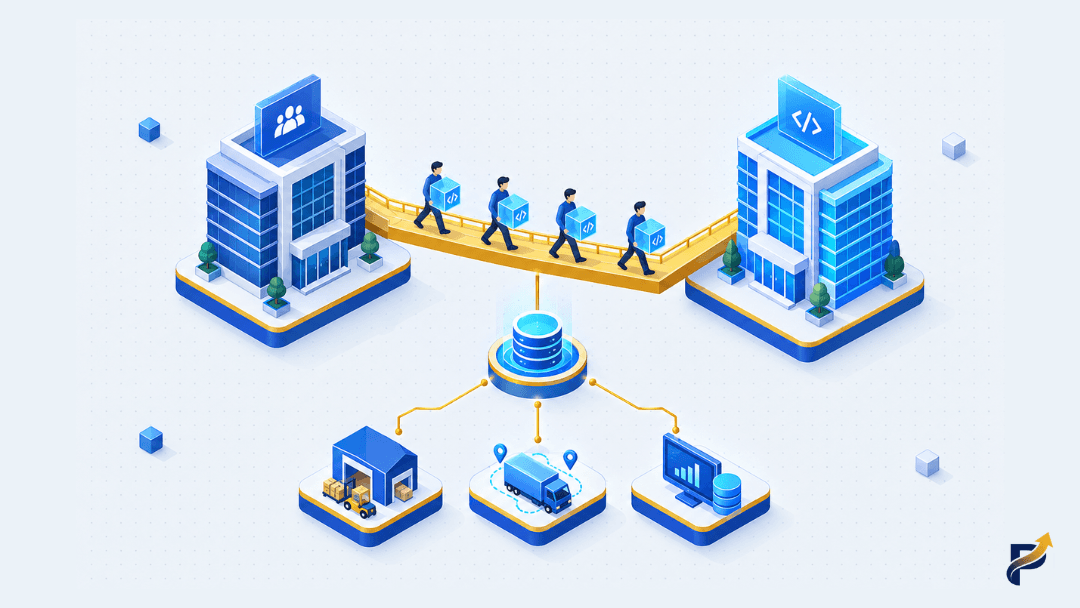
WMS, TMS and ERP integration — connecting all three without creating a tangled mess of custom code — is one of the defining integration challenges for logistics operators in 2026, and getting it wrong costs more than most operators realise. This guide compares the main integration patterns, the failure modes each one exposes you to, and a practical way to decide what to synchronise and what to queue.
Why Point-to-Point Integration Breaks at Scale (And What to Do Instead)
Let's start with how most logistics companies built their integrations. A developer writes a direct connection between the WMS and the ERP. Then someone needs the TMS to talk to the ERP too. Then the WMS needs shipment status from the TMS. Before long, you have six or seven individual connections, each one custom-built, each one brittle.
This is called point-to-point integration, and the problem isn't immediately obvious — it works fine on day one. The trouble is that the number of possible connections grows much faster than the number of systems — roughly n × (n − 1) ÷ 2. Add a fourth system (say, a carrier API aggregator or a customs compliance platform) and you're not adding one new connection. You're potentially adding a connection to every existing system. With five platforms, you can have up to ten direct connections to maintain. With eight, that number jumps to twenty-eight.
When a field name changes in your ERP upgrade, every one of those connections breaks independently. Your team then plays whack-a-mole fixing failures across systems they didn't know were related.
This pattern routinely derails software upgrade cycles. A typical scenario: an ERP migration planned for six weeks stretches into months, because every point-to-point connection to the WMS and carrier TMS platforms has to be found, re-mapped and re-tested. The hidden cost of brittle connections is almost always measured in delayed upgrades and emergency developer sprints.
The alternative isn't glamorous, but it works. Hub-and-spoke architecture routes all system communication through a central integration layer — often called an iPaaS (Integration Platform as a Service, meaning a cloud-hosted tool that manages connections between your software). Each system talks to the hub, not to each other. Add a new platform and you build one new connection to the hub, not one to every existing system.
The next evolution is event-driven architecture, where systems publish notifications (events) when something changes — a shipment departs, a stock count updates, an invoice posts — and other systems subscribe to only the events they care about. Think of it like a company-wide announcement board rather than each department emailing every other department directly.
As IBM explains, API-led connectivity integrates applications through reusable, managed APIs rather than one-off connections. Combined with event-driven messaging, this approach decouples systems from each other, allowing one platform to evolve without forcing changes in everything connected to it. That decoupling is what makes your stack upgradeable without catastrophe.
WMS, TMS and ERP Integration Patterns Compared: What Each Approach Costs You
Here's where we need to be honest with you. Every integration pattern involves trade-offs. There's no universal "best" approach — only the right fit for your transaction volumes, SLA commitments, and team capacity. The table below maps the three main patterns against the failure modes your team will actually encounter.
| Integration Pattern | Typical Setup Complexity | Resilience When Carrier API Is Down | Risk of Duplicate Consignments | Status Desynchronisation Risk | Best Fit For |
|---|---|---|---|---|---|
| Point-to-Point | Low initially, high long-term | Poor — cascading failures likely | High | Very High | Single-system integrations only |
| Hub-and-Spoke (iPaaS) | Medium | Medium — hub becomes single point of failure | Medium with retry logic | Medium | Growing operators with 3–6 platforms |
| Event-Driven (Async Messaging) | High initially | High — systems queue and retry independently | Low with idempotent design | Low | High-volume, real-time logistics networks |
| Hybrid (Sync API + Async Events) | High | High — sync for critical paths, async for updates | Low | Low | Enterprise operators with complex SLAs |
| Batch File Transfer (EDI/SFTP) | Low | Medium | Medium | Very High | Legacy partner integrations only |
The failure modes column matters more than most architects admit during design phase. When a carrier API goes down — and it will, typically at the worst possible moment during peak season — your integration architecture determines whether that outage causes a silent data gap or a system-wide status freeze.
With point-to-point, a carrier API timeout often causes the TMS to hang, which blocks the WMS from receiving shipment confirmations, which leaves the ERP waiting for goods-issue postings. One external failure becomes three internal ones.
With an event-driven pattern, the TMS publishes what it knows to a message queue. The carrier API failure is isolated. When the carrier recovers, the TMS processes the queued responses and publishes shipment events. The WMS and ERP pick those up asynchronously. Operationally, your team sees a slight delay — not a blackout.
The duplicate consignment problem is a specific failure mode worth calling out. When connecting WMS, TMS, and ERP systems that retry failed transactions, non-idempotent API calls (meaning the same request processed twice creates two records) generate duplicate shipments. A single peak-day incident can generate dozens — even hundreds — of duplicate consignments when retry logic isn't designed with idempotency keys. Making your shipment-creation API calls idempotent — meaning processing the same request twice produces the same result, not two results — should be a non-negotiable design requirement.
The Data Governance Problem Nobody Talks About Enough
Here's a counter-intuitive truth: many WMS-TMS-ERP failures aren't caused by bad code. They're caused by unclear data ownership.
Consider stock levels. The WMS tracks physical inventory in the warehouse. The ERP tracks inventory value for financial reporting. The TMS tracks goods in transit. When these three systems disagree about how many units of a SKU exist, who is right? If you don't define the answer before you build the integration, your systems will spend years reconciling against each other.
Master data governance — a defined set of rules about which system "owns" each type of data — is one of the highest-leverage activities you can complete before any integration project begins. Organisations that successfully move away from middleware sprawl typically establish data ownership domains first, with integration logic serving those boundaries rather than blurring them.
A practical domain split for most logistics operators looks like this: the WMS owns inventory location and physical stock counts; the TMS owns shipment records, carrier assignments, and transit status; the ERP owns financial postings, purchase orders, and supplier master data. When a discrepancy occurs, the governance model defines which system's record takes precedence and triggers the reconciliation workflow.
Stock drift — where WMS and ERP inventory counts gradually diverge over weeks — is almost always a governance failure, not a technical one. The integration is working, but it's synchronising the wrong fields, or both systems are independently adjusting the same inventory record.
Clear data ownership also speeds up incident resolution: when everyone knows which system is the source of truth, nobody wastes time debating which record to trust. That matters — in a fulfilment operation running on two-hour SLAs, incident resolution time directly affects customer experience.
One practical recommendation: before you write a single line of integration code, produce a one-page data ownership matrix. List every data entity that crosses system boundaries — orders, shipments, inventory, invoices, purchase orders, carrier events. For each one, define the system of record, which systems receive read copies, and the reconciliation rule when they conflict. It sounds bureaucratic. It saves months.
Even if your team is small — even if you're running the IT function yourself alongside other responsibilities — this document costs you a few hours and prevents expensive reconciliation failures down the line.
A Practical Guide to Deciding What to Queue and What to Synchronise
Not every integration needs to be real-time. Getting this decision wrong in either direction causes problems.
Make an integration synchronous (meaning the calling system waits for an immediate response) when the user or process cannot proceed without confirmation. Order validation is a classic example. When your order management system sends a new order to the WMS, it needs an immediate acknowledgement that the WMS accepted it before confirming to the customer. Making that call asynchronous creates a window where the customer has a confirmation but the WMS hasn't received the order.
Make an integration asynchronous (meaning the calling system sends a message and continues without waiting) when a slight delay is acceptable and resilience matters more than immediacy. Shipment status updates from a carrier are the clearest example. The TMS doesn't need to freeze while waiting for a carrier tracking API to respond. It publishes the tracking request to a queue, the carrier responds when available, and the TMS processes the event. During carrier API outages, messages queue rather than transactions fail.
A practical decision guide for connecting WMS, TMS, and ERP systems:
- ▸Synchronous: Order creation confirmation, inventory reservation, payment authorisation, shipment booking acknowledgement
- ▸Asynchronous: Carrier tracking updates, inventory reconciliation runs, financial posting notifications, proof-of-delivery events, label printing queues
This is the classic Idempotent Receiver pattern from Gregor Hohpe and Bobby Woolf's Enterprise Integration Patterns, and it belongs in the event schema design phase, not as an afterthought. An idempotency key — a unique identifier for each business event — added at design costs almost nothing. Added during incident remediation, it costs days.
Looking ahead to 2027, we expect AI-assisted routing to become embedded in the orchestration layer itself. Rather than static rules defining synchronous-versus-asynchronous decisions, orchestration hubs will dynamically route messages based on real-time system load, SLA breach risk, and historical failure patterns. The architecture you build today should be flexible enough to accommodate that shift — which is another argument against rigid point-to-point designs.
For budget-conscious operators, the good news is that even small teams can implement event-driven integration patterns using managed cloud services. Azure Service Bus, AWS SQS, or Google Cloud Pub/Sub remove the need to manage your own message queue infrastructure, lowering the operational overhead significantly. Azure Service Bus, for example, provides enterprise-grade messaging with built-in retry policies and dead-letter queues — the mechanism that catches messages that repeatedly fail processing — without requiring specialist infrastructure engineers on your payroll.
Domain-driven design principles, which treat each of your platforms as an independent bounded context with clearly defined API contracts, give your developers a framework for building integrations that don't require system-wide regression testing every time one platform changes. You don't need a huge budget to apply these principles — you need developers who understand them and a clear mandate to apply them consistently.
How PapaSiddhi Can Help
If you're managing a logistics stack where WMS, TMS, and ERP platforms are drifting apart — or planning an integration project from scratch — PapaSiddhi's logistics and transport software and IT outsourcing services teams give you access to experienced developers who can design and build these integration patterns for you.
Our services cover ERP integration, API development and Microsoft Dynamics 365 Business Central projects. On every integration engagement, we follow the approach in this guide: define data ownership first, design idempotent APIs, and choose synchronous and asynchronous boundaries deliberately — before a line of integration code is written.
You don't need a full in-house integration team to get this right. Through our hire developers model, you can onboard a qualified integration specialist within 48 hours. We work with clients in the USA, UK, Netherlands, UAE, Saudi Arabia, Australia, Singapore and across Europe, and we understand the operational pressure of getting these systems to agree with each other.
Talk to our team for a free consultation. We'll review your current integration architecture and identify the highest-risk failure points before they become incidents.
Conclusion
Connecting WMS, TMS, and ERP systems without accumulating middleware sprawl is achievable — but it requires deliberate architectural choices, not just more integrations. The pattern you choose determines your resilience during carrier API outages, your exposure to duplicate consignments, and how painfully expensive your next platform upgrade becomes.
Start with data ownership governance. Choose your synchronous and asynchronous boundaries deliberately. Design for idempotency from day one. And build on a loosely coupled architecture that lets your stack evolve without cascading failures.
The systems that disagree today don't have to stay that way. The question is whether you fix the architecture or keep patching the symptoms.
Frequently Asked Questions
Common questions about WMS TMS ERP integration answered by the PapaSiddhi expert team.